

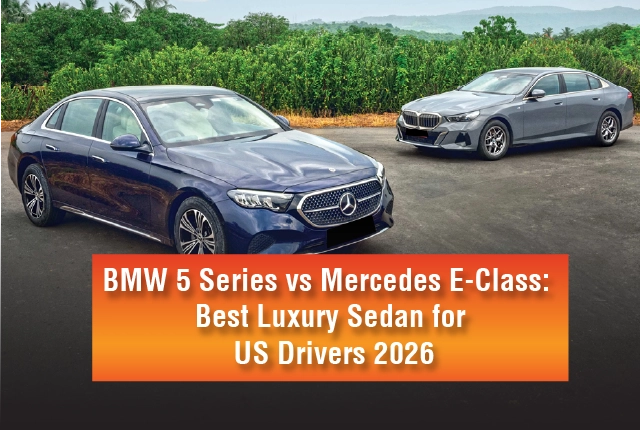
For over three decades, the mid-size luxury sedan category in the United States has been anchored by two dominant players: the BMW 5 Series and the Mercedes-Benz E-Class. These models are not just vehicles, and they are benchmarks that define what executive mobility should feel like.
In 2026, however, this rivalry has evolved beyond traditional metrics like horsepower and interior materials. Today’s U.S. buyer expects seamless technology integration, electrification readiness, real-world efficiency, and long-distance comfort, all wrapped in a premium driving experience.
Whether you’re navigating the congestion of Los Angeles freeways, commuting between suburbs and city centers, or covering long interstate distances, choosing the right luxury sedan requires a deeper understanding of how these vehicles perform in real American driving conditions.
This blog provides a fact-based, structured comparison designed to help you evaluate both sedans from a practical, ownership-focused perspective.
Key Comparison Table for the USA in 2026
| Category | BMW 5 Series | Mercedes-Benz E-Class |
| Base Engine | 2.0L Turbo (530i) | 2.0L Turbo Mild Hybrid (E 350) |
| Power Output (Base) | 255 hp | 255 hp |
| Top Variant | 550e xDrive PHEV (~489 hp) | AMG E53 Hybrid (604 hp) |
| 0 – 60 mph (Top) | 4.1 sec | ~3.7 – 3.9 sec |
| Fuel Efficiency | Up to ~35 MPG highway | Strong city efficiency |
| Electrification | Plug-in Hybrid (EV mode) | Mild Hybrid / Hybrid |
| Infotainment | iDrive 8.5 / 9.0 | MBUX Superscreen |
| Trunk Space | 18.4 cu ft | 12.7 cu ft |
| Special Variant | Nil | All-Terrain Wagon (U.S.) |
| Starting Price | $61,000 | $63,000 |
Performance & Driving Dynamics: Engagement vs Refinement
The most fundamental difference between these two sedans lies in how they approach driving.
The BMW 5 Series continues to prioritize driver engagement. Even in its base 530i configuration, the chassis tuning, steering feedback, and weight distribution provide a level of responsiveness that stands out in this segment. The 550e xDrive plug-in hybrid further enhances this experience by combining electric torque with a turbocharged engine, delivering strong acceleration without sacrificing efficiency.
On U.S. highways, particularly during merging and overtaking, this translates into confident, immediate power delivery. The car feels composed at high speeds and agile in tighter conditions, making it suitable not just for commuting but also for drivers who value control and feedback.
In contrast, the Mercedes-Benz E-Class is engineered with a different priority whereas ride comfort and isolation. Its mild-hybrid system ensures smooth acceleration, especially in stop-and-go traffic, where the transition between engine states is nearly imperceptible. The optional suspension plays a critical role here, absorbing road imperfections and maintaining cabin stability.
For long-distance interstate travel, common in the U.S., the E-Class delivers a more relaxed experience. Wind noise is minimal, ride quality is consistently smooth, and driver fatigue is noticeably reduced over extended journeys.
In practical terms:
- BMW suits drivers who enjoy being actively involved behind the wheel
- Mercedes suits those who prioritize comfort and consistency over long distances
Powertrain Strategy & Electrification: Two Different Approaches
Electrification is no longer optional in 2026, and it is a defining factor.
BMW has taken a plug-in hybrid approach, particularly with the 550e xDrive. This allows for short-distance electric-only driving, which is highly relevant for suburban U.S. commuters with access to home charging. For daily drives under 30 – 40 miles, fuel consumption can be significantly reduced.
Mercedes-Benz, on the other hand, focuses on mild-hybrid systems across most of the E-Class lineup. These systems enhance efficiency and smoothness but do not provide full electric driving capability. The advantage here is simplicity, and no charging infrastructure is required.
From a U.S. ownership perspective:
- BMW offers greater potential cost savings for drivers who can utilize EV mode regularly
- Mercedes provides consistent efficiency without behavioral changes, making it easier to adapt
Interior & Technology: Digital Experience vs Functional Design
Technology is one of the most visible differentiators between the two models.
The Mercedes-Benz E-Class introduces the MBUX Superscreen, a large, continuous display spanning the dashboard. This system integrates multiple functions into a visually cohesive interface, including a dedicated passenger screen. It creates a more immersive and entertainment-focused cabin environment.
For U.S. professionals who spend a significant amount of time on the road, this setup effectively transforms the vehicle into a connected workspace, seamlessly handling navigation, communication, and entertainment needs.
BMW’s approach with the 5 Series is more restrained but equally effective. Its curved display running iDrive 8.5/9.0 emphasizes clarity and usability. The interface is structured to minimize distraction, with logical menu layouts and responsive controls.
A notable addition is the AirConsole gaming feature, which allows passengers to use smartphones as controllers. While not essential, it highlights BMW’s effort to enhance the in-car experience during idle periods.
Key distinction:
- Mercedes emphasizes visual impact and passenger engagement
- BMW focuses on driver usability and system efficiency
Space, Comfort & Practicality: Designed for U.S. Lifestyles
In the U.S., practicality is a critical consideration, often more so than in European markets.
The BMW 5 Series offers a larger trunk capacity, making it more suitable for everyday needs such as airport travel, business equipment, or family usage. This added space provides a tangible advantage in daily scenarios.
The Mercedes-Benz E-Class, while offering less trunk space in sedan form, compensates with the All-Terrain wagon variant. This model provides significantly more cargo capacity and flexibility, appealing to buyers who require additional storage but prefer sedan-like driving dynamics over SUVs.
Rear seat comfort in both vehicles is competitive, with ample legroom and premium seating materials. However, Mercedes maintains a slight edge in seat cushioning and long-distance comfort, particularly for rear passengers.
Fuel Efficiency & Cost of Ownership
Fuel efficiency remains an important factor, especially given fluctuating fuel prices in the U.S.
The BMW 530i achieves up to 35 MPG on highways, making it one of the more efficient options in its class. The PHEV variant can further reduce fuel consumption when used strategically. Mercedes-Benz E-Class models excel in city driving conditions, where the mild-hybrid system improves efficiency during frequent stops and starts.
Ownership costs extend beyond fuel:
- BMW may benefit from state-level incentives for plug-in hybrids
- Mercedes may offer lower complexity in maintenance due to the absence of charging systems
Ultimately, cost efficiency depends heavily on driving patterns and infrastructure access.
Pricing & Market Positioning in the U.S.
Pricing for both models is closely aligned, reflecting their direct competition.
- The BMW 5 Series starts at approximately $61,000
- Mercedes-Benz E-Class starts at approximately $63,000
Higher trims and optional packages can increase prices significantly, often exceeding $80,000.
From a value perspective:
- BMW offers more performance per dollar, especially in hybrid trims
- Mercedes offers more perceived luxury and comfort features
Which Luxury Sedan Fits Your Needs?
The decision between the BMW 5 Series and Mercedes-Benz E-Class is not about superiority and it is about alignment with your priorities.
Choose the BMW 5 Series if you want:
- Engaging driving dynamics
- Higher practicality in sedan form
- Plug-in hybrid efficiency for daily commuting
Choose the Mercedes-Benz E-Class if you want:
- Maximum ride comfort and refinement
- Advanced, immersive interior technology
- Greater versatility with wagon configuration
Frequently Asked Questions
1. Which is better for daily commuting in the U.S.?
The BMW 5 Series PHEV is ideal for short commutes with charging access, while the Mercedes E-Class offers consistent comfort in all conditions.
2. Which luxury sedan has better technology in 2026?
Mercedes leads with its Superscreen interface, while BMW offers a more intuitive and driver-focused system.
3. Is the BMW 5 Series more fuel-efficient than the E-Class?
On highways, yes. However, the E-Class performs better in city conditions due to its mild-hybrid system.
Final Thoughts
The BMW 5 Series vs Mercedes-Benz E-Class USA 2026 comparison highlights how the luxury sedan segment is evolving. Buyers are no longer choosing between just performance and comfort, and they are evaluating technology ecosystems, efficiency strategies, and real-world usability.Both models deliver exceptional value within their segment, but their differences are clear enough to guide a confident decision. For more expert insights, car-buying strategies, and the latest U.S. automotive trends, have a look at Mr.Leecar, your go-to destination for car news, reviews, and upcoming launches.

