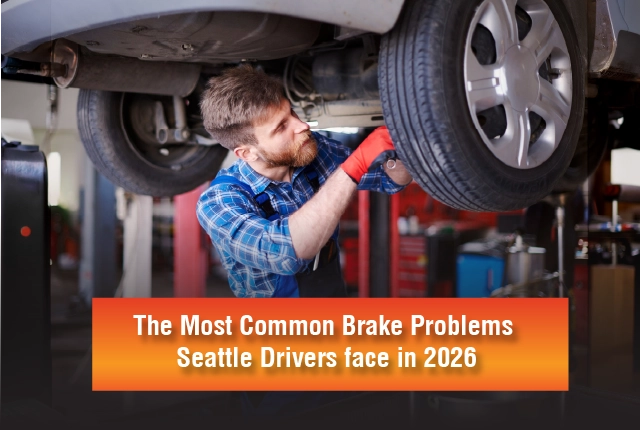
Drivers across Seattle are feeling the impact of the city’s growing traffic congestion more than ever in 2026. Long waits on I-5, packed downtown intersections, and constant stop-and-go movement have become part of everyday life for local commuters.
But traffic is doing more than wasting fuel and increasing commute times. It’s quietly damaging one of the most important safety systems in your vehicle and your brakes.
Seattle’s combination of steep hills, wet roads, heavy traffic, and frequent braking creates ideal conditions for accelerated brake wear. Unlike flat highway driving, Seattle roads constantly force your braking system to work harder, especially in neighborhoods with sharp inclines and downhill descents like Queen Anne and Capitol Hill.
As more drivers face expensive repairs in 2026, understanding how local driving conditions impact your vehicle can help you avoid dangerous failures and costly damage.
Why Seattle Driving Conditions Are So Hard on Brakes
Seattle presents a unique challenge for modern vehicles. The city’s terrain alone places additional stress on braking systems, but when combined with dense traffic and rainy conditions, the wear becomes even more aggressive.
Drivers rarely get the chance to maintain steady cruising speeds. Instead, most commutes involve repeated stopping, downhill braking, and constant pedal pressure in traffic. Continuous stop-and-go driving gradually causes excessive heat buildup throughout the braking system.
Rain also plays a major role. Wet pavement reduces traction, causing drivers to brake more frequently and more carefully. At the same time, Seattle’s moisture-heavy climate contributes to brake fluid contamination and corrosion within hydraulic components.
The result is a much shorter lifespan for brake pads, rotors, and fluid compared to vehicles driven in flatter or drier parts of the country.
Premature Brake Pad Wear Is Becoming Increasingly Common
One of the most common brake issues Seattle drivers are experiencing in 2026 is rapid brake pad deterioration. Brake pads are designed to absorb friction during braking, which causes them to deteriorate gradually with regular use. However, Seattle traffic and steep downhill driving accelerate this process dramatically.
Many drivers unknowingly keep steady pressure on the brake pedal while descending hills during heavy traffic. This constant friction creates excessive heat, causing pads to wear much faster than expected. In many parts of the United States, brake pads may last between 40,000 and 70,000 miles. In Seattle, drivers often require replacements much earlier, especially when commuting daily through congested urban routes. If you hear squealing noises while braking or notice reduced stopping performance, your brake pads may already be approaching the end of their usable lifespan.
Warped Rotors are Another Major Problem for Seattle Drivers
Brake rotors are also taking a heavy beating from Seattle’s driving environment.
Repeated downhill braking generates significant heat inside the rotors. As extremely hot brake components hit cold rainwater, the immediate temperature change causes uneven expansion and contraction. This repeated expansion and contraction can eventually distort the rotor surface.
Once rotors become uneven, drivers usually begin noticing vibrations during braking. In some cases, the steering wheel may shake while slowing down at higher speeds or during downhill stops. Warped rotors not only reduce braking smoothness but can also affect stopping efficiency and overall vehicle stability during emergency braking situations.
Seattle’s Wet Climate Is Affecting Brake Fluid Performance
Another growing concern in 2026 is brake fluid contamination caused by moisture exposure.
Brake fluid naturally absorbs moisture over time, and Seattle’s rainy climate speeds up that process considerably. As water content increases inside the braking system, the fluid’s boiling point decreases and internal corrosion can begin developing inside brake lines and hydraulic components.
This often leads to a soft or spongy brake pedal feel that many drivers notice during stop-and-go traffic. When brake fluid loses effectiveness, the entire braking system becomes less responsive. Drivers may feel like the vehicle takes longer to stop or requires extra pedal pressure to slow down safely.
Routine brake fluid inspections and periodic flushing are becoming increasingly important for Seattle commuters who drive regularly in heavy traffic and wet conditions.
Smart Driving Habits Can Help Reduce Brake Wear
Seattle’s traffic and terrain may be unavoidable, but proper driving techniques can greatly reduce strain on your braking system.
Using engine braking while descending steep hills helps lower the amount of continuous pressure placed on brake pads and rotors. Increasing following distance in traffic also reduces constant braking and allows smoother deceleration.
Drivers investing in premium ceramic brake pads are also seeing better long-term performance under Seattle’s demanding conditions. These pads typically handle heat more effectively and maintain consistent braking performance during prolonged downhill driving.
How Often Should Seattle Drivers Check Their Brakes?
Because of the city’s steep terrain and severe stop-and-go traffic, many local technicians recommend brake inspections every six months or roughly every 7,500 miles. This is significantly more frequent than standard recommendations in less demanding driving environments.
Regular inspections can identify early signs of wear before they develop into expensive repairs or dangerous failures.
| Maintenance Item | Recommended Frequency |
|---|---|
| Brake Inspection | Every 6 months or 7,500 miles |
| Brake Pad Check | During every routine service |
| Brake Fluid Inspection | Every 1–2 years |
| Rotor Inspection | During brake pad replacement |
| Full Brake System Service | Based on driving conditions and wear level |
Final Thoughts
Seattle’s roads are becoming increasingly demanding on modern vehicles. Between traffic congestion, steep hills, wet pavement, and constant braking, local drivers are facing faster brake wear than ever before. Ignoring early warning signs like squealing noises, pedal vibrations, or reduced braking response can quickly lead to larger mechanical problems and serious safety risks.
Staying proactive with inspections, using smarter driving techniques, and investing in high-quality brake components can help extend the lifespan of your braking system and improve safety on Seattle roads. For more automotive maintenance insights, repair guides, industry updates, and U.S. car trends, Just have a look at Mr.Leecar Experts.