

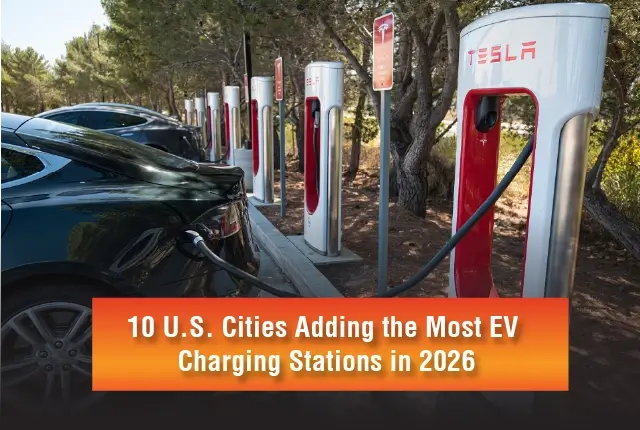
Electric vehicles have moved beyond being a future possibility and are now becoming a mainstream part of everyday life across America. As EV adoption continues to break records, cities nationwide are racing to build the charging infrastructure needed to support millions of electric drivers.
According to recent industry data, public DC fast-charging networks are expanding by more than 1,000 new charging stalls every month. What makes 2026 particularly interesting is that growth is no longer limited to traditional EV strongholds like California. Cities across the Midwest, Northeast, Southwest, and Pacific Northwest are rapidly investing in next-generation charging networks designed to meet rising consumer demand.
The latest EV infrastructure expansion 2026 USA trends reveal a new generation of charging strategies focused on convenience, reliability, and accessibility. Municipal governments, private charging operators, utilities, automakers, and commercial property owners are collaborating to deploy faster, smarter, and more dependable charging solutions.
Across the country, cities are investing in smarter charging solutions from New York City’s expanding curbside infrastructure to Southern California’s solar-powered charging systems and reshaping the EV ownership experience for millions of drivers. Let’s explore the top 10 cities leading the EV infrastructure expansion 2026 USA movement and see where the newest EV charging ports by city 2026 are making the biggest impact.
Rank | City | State | Growth Focus |
1 | Los Angeles | California | Fast-charging hubs |
2 | New York City | New York | Curbside charging |
3 | Philadelphia | Pennsylvania | Community charging |
4 | Detroit | Michigan | Corridor networks |
5 | San Diego | California | Solar-powered charging |
6 | Chicago | Illinois | Retail & transit charging |
7 | Austin | Texas | Smart charging initiatives |
8 | Long Beach | California | Fleet electrification |
9 | Seattle | Washington | Residential charging |
10 | Phoenix | Arizona | Highway fast charging |
1. Los Angeles, California
Few cities are as closely tied to car culture as Los Angeles, making it a natural leader in EV infrastructure growth. As one of the nation’s largest EV markets, Los Angeles continues to expand its charging ecosystem at an impressive pace. The city is increasingly prioritizing large-scale DC fast-charging hubs capable of serving dozens of vehicles simultaneously.
With an emphasis on convenience and scalability, charging providers are building centralized facilities that accommodate:
- Apartment residents without a home are charging
- Delivery and logistics fleets
- Ride-share drivers
- Long-distance travelers
The city’s ambitious sustainability goals and strong EV adoption rates make Los Angeles one of the most influential charging markets in America.
2. New York City, New York
New York faces unique charging challenges due to limited private parking and dense urban development. To address these issues, the city has aggressively expanded curbside charging infrastructure throughout all five boroughs. Charging infrastructure is becoming more visible across neighborhoods, commercial centers, and community-owned properties.
The city’s electrification strategy is also heavily focused on:
- Taxi fleet electrification
- Ride-share vehicle charging
- Public transportation support
- Multi-family housing accessibility
As EV ownership rises, New York is setting a national example for urban charging deployment.
3. Philadelphia, Pennsylvania
Philadelphia has emerged as one of the most surprising EV infrastructure success stories of 2026. Philadelphia is expanding its charging network with plans to add hundreds of public EV chargers across residential communities. Unlike many cities focused solely on commercial corridors, Philadelphia is prioritizing equitable charging access.
Key initiatives include:
- Residential neighborhood charging
- Community-based charging hubs
- Public curbside installations
- Improved accessibility for residents without garages
- Residential neighborhood charging
- Community-based charging hubs
- Public curbside installations
- Improved accessibility for residents without garages
This neighborhood-first approach is helping remove one of the biggest barriers to EV ownership in urban communities.
4. Detroit, Michigan
Detroit’s transformation from automotive manufacturing capital to electric mobility leader continues to gain momentum. Driven by Michigan’s significant statewide EV infrastructure investments, Detroit is rapidly expanding charging availability along major transportation corridors and within city limits.
Automakers headquartered in the region are helping accelerate deployment through:
- Public-private partnerships
- Workplace charging projects
- Fleet electrification programs
- Community charging investments
5. San Diego, California
San Diego is becoming one of the most innovative EV charging cities in the USA 2026 destinations. The area’s charging strategy goes beyond traditional grid-connected stations, embracing renewable energy solutions powered by solar panels and battery storage.
These advanced installations offer several benefits:
- Reduced strain on the electric grid
- Faster deployment timelines
- Increased sustainability
- Greater flexibility for high-demand areas
The ability to install these stations without extensive utility improvements helps accelerate deployment while reducing project costs.
6. Chicago, Illinois
Chicago is leading EV infrastructure growth throughout the Midwest. Illinois has recorded impressive charging network expansion, and Chicago remains the focal point of much of that development. Charging providers are strategically targeting locations where drivers already spend time.
Popular installation sites include:
- Grocery stores
- Shopping centers
- Transit hubs
- Public parking facilities
- Workplace campuses
The city’s focus on convenience is helping normalize charging as part of everyday life rather than a separate activity.
7. Austin, Texas
Austin’s tech-forward culture has made it an ideal testing ground for innovative charging solutions. The city combines smart urban planning with rapidly expanding EV adoption, creating an ecosystem where charging infrastructure naturally integrates into community spaces. Many charging locations are situated near:
- Parks and walking trails
- Entertainment districts
- Mixed-use developments
- Public gathering spaces
This approach allows drivers to charge their vehicles while enjoying local amenities, improving the overall ownership experience.
8. Long Beach, California
Long Beach is proving that mid-sized cities can become major EV infrastructure leaders. The city has invested heavily in solar-powered charging systems that support municipal operations, airport facilities, and public fleet vehicles. Notable advantages include:
- Renewable energy integration
- Reduced operating costs
- Enhanced energy independence
- Sustainable fleet management
As port cities seek cleaner transportation solutions, Long Beach provides a practical blueprint for future expansion.
9. Seattle, Washington
Seattle continues to strengthen its position as one of America’s most EV-friendly metropolitan areas. Washington consistently ranks among the states with the highest EV adoption rates, and Seattle’s infrastructure investments are helping keep pace with demand.
Recent efforts focus heavily on:
- Multi-family residential developments
- Workplace charging
- Retail destination charging
- Updated zoning requirements
By incorporating charging into new construction projects, Seattle is creating long-term infrastructure resilience.
10. Phoenix, Arizona
Phoenix is experiencing some of the fastest metropolitan growth in the United States, and EV charging infrastructure is expanding alongside it. The city’s strategy focuses on connecting suburban communities through extensive fast-charging corridors. Major deployment areas include:
- Highway travel routes
- Shopping centers
- Entertainment districts
- Regional commuter corridors
These investments are making EV ownership increasingly practical for Arizona’s rapidly growing population.
Also Read: Best Electric SUVs Under $50K in 2026
The New EV Infrastructure Strategy: Reliability Matters More Than Quantity
A major shift is occurring across the EV industry. For years, success was measured primarily by how many charging stations were installed. Today, reliability, uptime, and charging speed are becoming the metrics that matter most. As a result, cities are prioritizing installations near places people already visit daily, including grocery stores, shopping centers, restaurants, workplaces, and recreation areas. The future of EV charging isn’t simply about building more chargers, and it’s about building better charging experiences.
What These Trends Mean for EV Owners
For drivers, the rapid expansion of EV charging ports by 2026 offers several advantages:
Faster Charging Access
More DC fast chargers mean shorter wait times and improved travel flexibility.
Greater Neighborhood Coverage
Residential charging projects are making EV ownership practical for apartment dwellers and urban residents.
Improved Long-Distance Travel
Expanded highway corridors reduce range anxiety and support cross-country EV travel.
Better Reliability
Newer charging stations typically offer higher uptime rates and improved performance.
Lower Charging Costs
Competition among charging providers may help keep charging prices competitive in many markets.
Final Thoughts: The Future of EV Infrastructure Expansion in the USA
The next phase of EV infrastructure expansion, 2026 USA initiatives, will likely focus on intelligent charging networks, renewable energy integration, and large-scale fast-charging deployments. As EV adoption continues to accelerate, cities that invest early in reliable charging infrastructure will be better positioned to attract residents, businesses, and future transportation technologies. Whether you’re already driving electric or considering your first EV purchase, one thing is clear: America’s charging network is growing faster, smarter, and more accessible than ever before.
Frequently Asked Questions
Which US cities are adding the most EV charging stations in 2026?
Los Angeles, New York City, Philadelphia, Chicago, Detroit, and Phoenix are among the fastest growing EV charging stations US cities, with significant investments in public charging infrastructure and fast-charging networks.
Where can I find new EV charging ports by city in 2026?
Most new EV charging ports by city 2026 are being installed at shopping centers, grocery stores, public parking lots, transit hubs, residential communities, and major highway travel corridors.
What is driving EV infrastructure expansion in the USA?
The EV infrastructure expansion 2026 USA surge is being fueled by rising EV adoption, private-sector investment, government incentives, automaker partnerships, fleet electrification programs, and growing consumer demand for fast and reliable charging options.
Looking for more expert insights on US car trends, automotive news, EV technology, and upcoming vehicle launches? Just have a look at Mr.Leecar which is your trusted source for the latest developments shaping the American automotive industry.


