

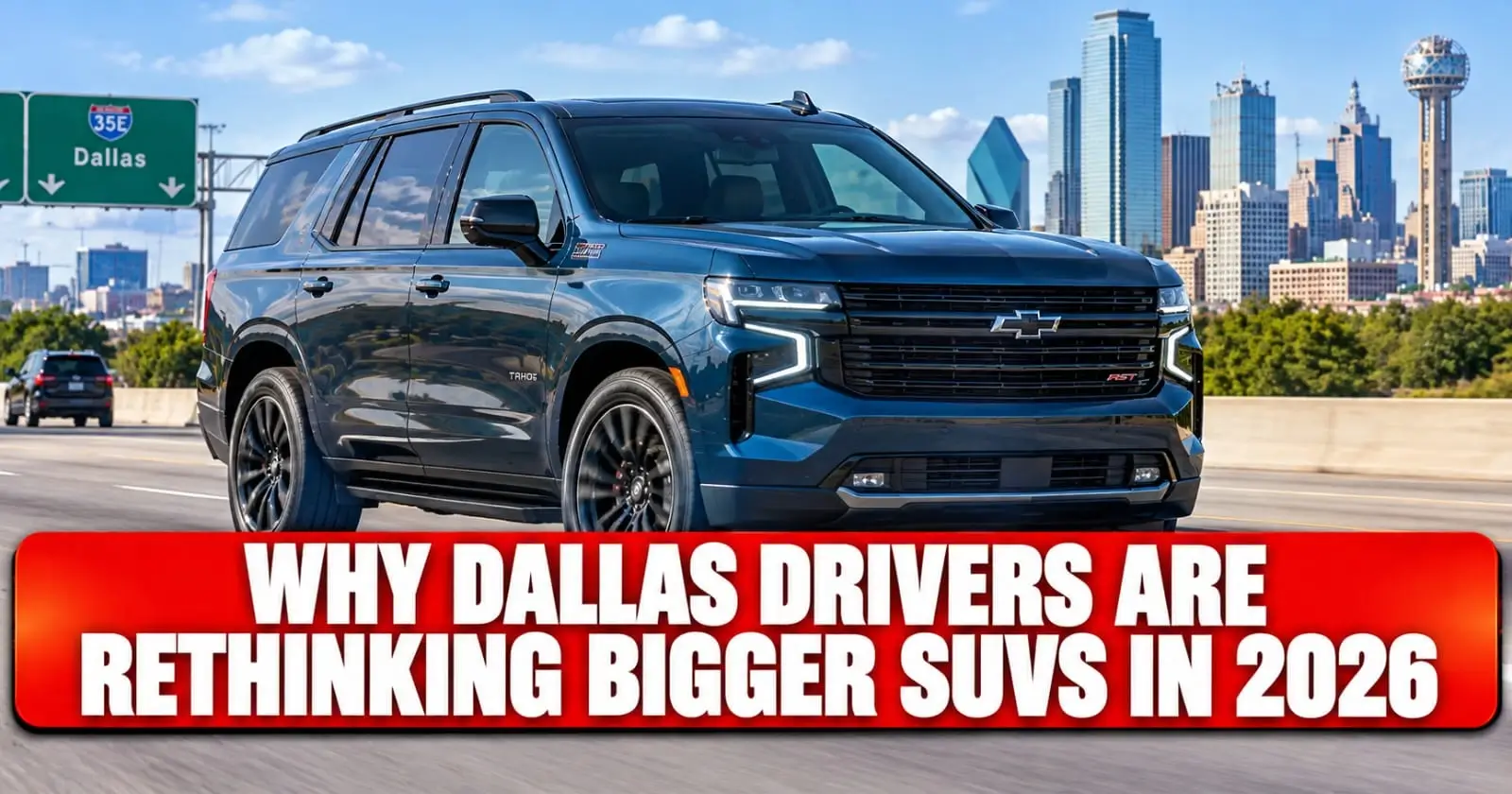
For years, bigger SUVs made perfect sense in North Texas. Families wanted three rows, contractors needed cargo space, and long stretches of highway made a large vehicle feel right at home. But the way Dallas-area residents use their vehicles is changing. Between daily congestion, rising ownership costs, crowded parking structures, and long commutes across the Metroplex, many drivers are beginning to question whether they really need a full-size SUV for everyday driving.
“For Dallas drivers, the right SUV is no longer the biggest one; it’s the one that works best every day”.
From Frisco and Plano to Irving, Arlington, and downtown Dallas, the modern DFW commute can put very different demands on an SUV than a weekend trip or a towing job. That is helping midsize, compact, and electrified SUVs become increasingly relevant to local buyers.
The Dallas Driving Environment Is Changing
Dallas is still a driving city. The Metroplex continues to spread outward, and many residents travel substantial distances for work, school, shopping, and family activities. Major routes such as Interstate 35E, US 75, Interstate 635, President George Bush Turnpike, and the Dallas North Tollway can become heavily congested during peak periods.
A vehicle designed primarily for towing, heavy hauling, or carrying large groups may spend much of its life doing something completely different: sitting in traffic, making school runs, commuting to an office, or navigating a shopping-center parking garage.
A full-size SUV can provide substantial passenger and cargo capacity, but its larger dimensions can make tight parking spaces, narrow garage ramps, and crowded urban streets more demanding. A midsize SUV can provide enough room for a family while being easier to maneuver during everyday driving.
Why Midsize SUVs Make More Sense for Many Dallas Drivers
The midsize SUV has become an important middle ground between compact crossovers and full-size SUVs. For many Dallas families, a midsize model can provide three-row seating, a useful cargo area, modern safety technology, and highway capability without reaching the dimensions of the largest SUVs.
That distinction becomes particularly useful for households that occasionally need extra passenger space but do not regularly tow heavy trailers or carry a full load of passengers and cargo.
Think about a typical week in the Metroplex. A driver may commute from Frisco toward Dallas, pick up children in Plano, make a grocery stop, navigate a crowded parking garage, and then head home through evening traffic. In that situation, maneuverability and efficiency may be more valuable than maximum towing capacity.
Fuel Efficiency Is Becoming Part of the SUV Decision
Fuel economy has always mattered, but it becomes more noticeable when an SUV is driven frequently. Long commutes and stop-and-go traffic can make the fuel consumption difference between a large gasoline SUV and an efficient hybrid crossover add up over thousands of miles.
That does not automatically make a hybrid the right choice for every driver. Texas drivers who regularly tow, haul equipment, or travel long distances in remote areas may have different priorities. However, someone whose SUV spends most of its time commuting may benefit from considering an efficient powertrain.
| SUV Type | Why It Can Work for Dallas Driving |
| Compact hybrid SUV | Efficient for commuting, easier to park, practical for small families |
| Midsize hybrid SUV | More passenger and cargo space while retaining strong fuel efficiency |
| Three-row hybrid SUV | Useful for larger families that want additional seating without a full-size footprint |
| Plug-in hybrid SUV | Can suit drivers whose daily trips are compatible with its electric driving capability |
| Gas-powered midsize SUV | Provides a balance of space, performance, and traditional refueling convenience |
The important point is to look beyond the EPA fuel-economy number. Dallas drivers should consider their actual mileage, traffic conditions, charging access if applicable, passenger needs, and how often they use the vehicle’s maximum capacity.
Three Rows Without the Full-Size Footprint
For families, one of the biggest reasons to choose a full-size SUV has traditionally been seating capacity. But today’s midsize SUV market offers more alternatives.
Models such as the Toyota Grand Highlander and other three-row midsize SUVs demonstrate how manufacturers are using interior packaging to provide family-friendly passenger space without relying entirely on a massive exterior footprint.
That can be particularly useful for Dallas-area families who need additional seats for children, grandparents, or carpooling but spend most weekdays driving through suburban and urban environments.
However, buyers should look closely at third-row dimensions before purchasing. Three-row SUVs are not identical. Some third rows work better for children, while others provide more usable space for adults. Cargo capacity also changes considerably when all seating positions are occupied.
Technology Is Changing the Daily SUV Experience
For Dallas commuters, driver-assistance features can be useful during long highway journeys. Adaptive cruise control, lane-centering assistance, blind-spot monitoring, rear cross-traffic alert, and automated emergency braking can help reduce the workload associated with routine driving.
These systems are not substitutes for an attentive driver. Their performance can vary depending on road markings, weather, traffic, and the specific system being used. For someone regularly traveling along busy Dallas-area highways, having a well-designed driver-assistance suite may be more useful every day than having an oversized engine that is rarely pushed to its limits.
Which SUVs Fit Different Dallas Driving Needs?
There is no single best SUV for Dallas drivers because DFW households have very different requirements. For a family that regularly travels across the Metroplex and needs three rows, a midsize three-row SUV or hybrid can offer a useful combination of space and efficiency.
For an individual commuter or smaller household, a compact hybrid such as a Honda CR-V Hybrid, Toyota RAV4 Hybrid, or Lexus NX Hybrid may provide enough space without unnecessary bulk.
For drivers who want premium features, vehicles such as the Lexus NX or BMW X5 offer different approaches to comfort, technology, and performance. And for drivers who need serious towing capability, downsizing may not make sense at all. A full-size SUV can still be the appropriate tool when its capabilities are regularly used.
The important distinction is between buying for occasional needs and buying for everyday needs. If a vehicle spends 95% of its life commuting and only 5% of its life performing heavy-duty work, it is worth asking whether that occasional requirement should determine the size of the vehicle you drive every day.
The Bigger Picture for Dallas SUV Buyers in 2026
The Dallas SUV market is not simply moving from large vehicles to small ones. The more significant change is the growing range of choices available to drivers.
A buyer can now choose among compact hybrids, midsize hybrids, three-row crossovers, plug-in hybrids, traditional gasoline SUVs, and larger body-on-frame models. That variety makes the shopping process more complicated, but it also gives Dallas drivers more opportunities to match a vehicle to their actual lifestyle.
For many households, the sweet spot may be a midsize SUV that provides enough room for family life while remaining manageable in traffic, parking garages, and everyday suburban driving. For others, a full-size SUV will continue to make sense because its towing, passenger, or cargo capabilities are genuinely needed.
The smartest approach is not to follow the biggest or smallest SUV trend. It is to evaluate how you actually drive.
Frequently Asked Questions
What are the major Dallas SUV trends for 2026?
Major Dallas SUV trends in 2026 include growing interest in hybrid powertrains, midsize three-row SUVs, advanced driver-assistance technology, and vehicles that balance passenger space with everyday maneuverability.
Why are Dallas drivers considering midsize SUVs instead of full-size SUVs?
Many Dallas SUV drivers are considering midsize models because they can provide useful passenger and cargo space while being easier to maneuver in traffic, parking garages, and suburban streets. Fuel efficiency can also be an important consideration for high-mileage commuters.
What are some fuel-efficient SUVs for Dallas commuters?
Options in the fuel-efficient SUV segment include hybrid models such as the Toyota RAV4 Hybrid, Honda CR-V Hybrid, Lexus NX Hybrid, and Toyota Grand Highlander Hybrid. The right choice depends on passenger needs, annual mileage, driving habits, and whether towing is required.
Final Takeaway
For Dallas drivers, choosing an SUV in 2026 is becoming less about going as big as possible and more about finding the right balance between space, efficiency, technology, and everyday usability. The best vehicle is the one that matches your actual driving needs, not simply the largest vehicle your budget allows.
If you have a car problem, need practical ownership advice, or want to stay updated on the latest vehicle trends, check out Mr. Leecar Experts for US-based car tips, automotive news, new launches, and everyday driving insights.


