

Buying a three-row SUV has become more challenging than ever, and that’s actually good news for American families.
Modern buyers want vehicles that feel refined enough for long highway journeys, offer intuitive technology that keeps everyone connected, provide advanced safety systems, and deliver enough cargo space to handle everything from grocery runs to camping gear. Fuel efficiency has also become a major purchasing factor as hybrid technology continues to gain popularity across the United States.
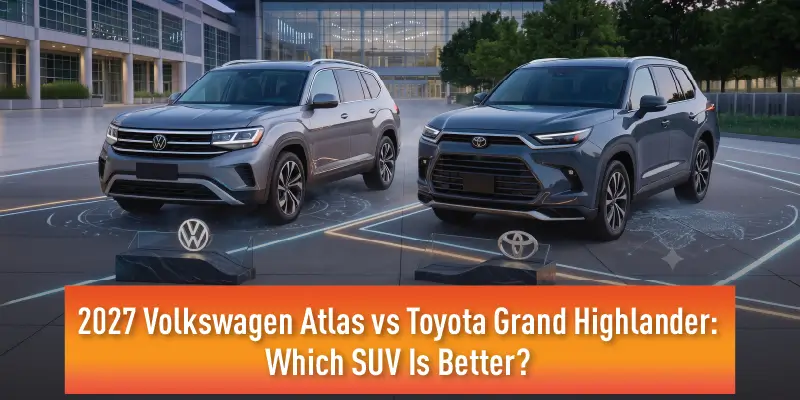
Two SUVs that perfectly represent this evolution are the 2027 Volkswagen Atlas and the Toyota Grand Highlander.
Volkswagen has completely reimagined the Atlas for 2027, introducing a more sophisticated design, a significantly upgraded cabin, and refined driving dynamics built on the latest MQB evo platform. Manufactured in Chattanooga, Tennessee, the new Atlas has been engineered with American families in mind while maintaining Volkswagen’s signature European driving characteristics. In this comprehensive 2027 Volkswagen Atlas vs Toyota Grand Highlander comparison, we’ll explore their design, interior technology, performance, practicality, and overall value to help you determine which model truly stands out as the Best 3-Row SUV of 2027.
Why This Comparison Matters for U.S. Buyers
The midsize three-row SUV segment has become one of the most competitive automotive categories in America.
For many American households, one vehicle now serves multiple purposes throughout the week. It may function as a commuter vehicle during weekdays, transport children to school and extracurricular activities, tow a small trailer or boat on weekends, and comfortably accommodate long-distance road trips during holidays.
Consumers no longer compare vehicles based solely on horsepower or cargo space. They now evaluate infotainment technology, driver-assistance systems, cabin refinement, fuel economy, ownership costs, and long-term reliability before making a purchase.
Exterior Design: European Sophistication Meets Everyday Practicality
Volkswagen has refined nearly every exterior detail to create a cleaner, more upscale appearance. A wider front grille, slimmer LED headlights, sculpted body lines, and redesigned rear lighting give the Atlas a more premium presence on American roads. Rather than appearing bulky, the new design feels balanced and modern while maintaining the upright proportions that have always contributed to its spacious interior.
The Toyota Grand Highlander takes a different design approach.
Instead of emphasizing bold styling, Toyota focuses on timeless functionality. Its longer wheelbase gives the SUV elegant proportions without appearing oversized, while subtle character lines and refined lighting help it blend contemporary styling with long-term durability. Buyers who prefer understated design may find the Grand Highlander particularly appealing because it prioritizes practicality over visual drama.
Inside the Cabin: Comfort, Technology, and Everyday Functionality
Volkswagen has significantly elevated interior quality, replacing the harder materials found in previous generations with soft-touch surfaces, genuine wood trim, premium ambient lighting, and a more sophisticated dashboard layout. The result is a cabin that feels considerably more expensive than its price suggests.
One of the smartest design improvements is the relocation of the electronic gear selector to the steering column. By eliminating the traditional center-mounted shifter, Volkswagen has created a far more usable center console that provides additional storage for handbags, tablets, water bottles, and other everyday essentials. For families who spend hours on the road, these practical improvements make a noticeable difference.
Technology has also taken a substantial leap forward.
A standard 12.9-inch infotainment display dominates the dashboard, while higher trims offer an impressive 15.0-inch touchscreen that rivals systems found in luxury SUVs. The updated software is faster, more intuitive, and supports wireless Apple CarPlay and Android Auto, allowing drivers to access navigation, music, and communication apps without plugging in their smartphones.
Toyota takes a noticeably different approach inside the Grand Highlander.
Rather than pursuing a luxury-inspired cabin, Toyota emphasizes simplicity and ease of use. The dashboard layout is clean, logically arranged, and designed around physical controls that remain easy to operate while driving. Climate functions continue to use dedicated buttons and rotary knobs, reducing distractions and allowing drivers to make quick adjustments without navigating touchscreen menus.
Storage is another area where Toyota shines.
The Grand Highlander provides generous door pockets, multiple storage compartments, USB-C charging ports across all three rows, and enough cupholders to keep every passenger happy during long road trips. These thoughtful details reinforce Toyota’s reputation for designing vehicles around real-world family needs rather than simply adding premium features.
2027 Volkswagen Atlas vs Toyota Grand Highlander: Key Specifications
| Feature | 2027 Volkswagen Atlas | Toyota Grand Highlander |
|---|---|---|
| Engine Options | 2.0L Turbocharged EA888 evo5 | 2.4L Turbo, Hybrid, Hybrid MAX |
| Horsepower | 282 hp | 265 hp (Gas), up to 362 hp (Hybrid MAX) |
| Transmission | 8-Speed Automatic | 8-Speed Automatic / eCVT |
| Drivetrain | FWD or 4MOTION AWD | FWD or AWD |
| Fuel Economy | Balanced turbo efficiency | Up to 36 MPG Combined (Hybrid) |
| Maximum Towing Capacity | 5,000 lbs | 5,000 lbs |
| Infotainment Display | 12.9-inch Standard / 15-inch Optional | 12.3-inch Touchscreen |
| Digital Driver Display | 10.3-inch Digital Cockpit Pro | 12.3-inch Digital Gauge Cluster (Available) |
| Third-Row Strength | Excellent headroom and easy access | Outstanding legroom and cargo space |
| Best Suited For | Premium driving experience and technology | Hybrid efficiency, reliability, and practicality |
Performance & Driving Experience: Two Different Approaches to Family Travel
The 2027 Volkswagen Atlas continues to rely on Volkswagen’s updated 2.0-liter EA888 evo5 turbocharged four-cylinder engine, now producing 282 horsepower with smoother power delivery and improved responsiveness. Paired with a refined eight-speed automatic transmission, the Atlas feels composed whether navigating city traffic or cruising at interstate speeds.
Toyota, however, offers buyers significantly more flexibility.
The Grand Highlander is available with three distinct powertrains, allowing shoppers to prioritize either affordability, efficiency, or outright performance. The standard turbocharged gasoline engine provides adequate acceleration for everyday driving, while the hybrid variant delivers exceptional fuel economy for commuters covering long distances each week.
Fuel Economy & Ownership Costs: Where Toyota Builds Its Biggest Advantage
As fuel prices continue to fluctuate across the United States, operating costs have become just as important as purchase price for many families. While performance and interior technology often attract buyers to a dealership, long-term fuel savings can significantly influence the total cost of ownership over several years.
Toyota offers three distinct powertrain choices, including a conventional gasoline engine, a fuel-efficient hybrid, and the performance-focused Hybrid MAX. The standard Grand Highlander Hybrid delivers up to 36 MPG combined, making it one of the most fuel-efficient three-row SUVs in its class. For families driving 15,000 to 20,000 miles annually, that efficiency can translate into substantial savings on fuel over the life of the vehicle.
The 2027 Volkswagen Atlas takes a different approach. Rather than introducing a hybrid powertrain immediately, Volkswagen has focused on refining its proven 2.0-liter turbocharged engine. The updated EA888 evo5 engine improves efficiency over previous generations while maintaining responsive performance for highway driving and daily commuting.
Final Thoughts
The competition between the 2027 Volkswagen Atlas vs Toyota Grand Highlander demonstrates just how far the modern family SUV has evolved.
The redesigned Atlas represents Volkswagen’s most complete three-row SUV to date. Its premium interior, refined driving dynamics, thoughtful technology integration, and spacious cabin make it feel like a vehicle positioned just below the luxury segment. Families looking for a more engaging driving experience without paying luxury-brand prices will find plenty to admire.
The Toyota Grand Highlander, on the other hand, continues to set the standard for practicality. With multiple powertrain options, outstanding fuel economy from its hybrid models, generous passenger space, and Toyota’s proven reputation for durability, it remains one of the smartest purchases in the midsize SUV market.
Frequently Asked Questions
Which is better for families: the 2027 Volkswagen Atlas or the Toyota Grand Highlander?
Both SUVs are excellent family vehicles, but they serve different needs. The 2027 Volkswagen Atlas offers a more premium interior, refined driving dynamics, and advanced technology, while the Toyota Grand Highlander stands out for its hybrid efficiency, spacious cabin, and long-term reliability.
Does the 2027 Volkswagen Atlas offer better fuel economy than the Toyota Grand Highlander?
No. The Toyota Grand Highlander Hybrid delivers up to 36 MPG combined, making it the more fuel-efficient choice. The Volkswagen Atlas focuses on balanced turbocharged performance and highway refinement rather than maximum fuel economy.
Which is the best 3-row SUV in 2027 for long road trips?
If you value premium comfort, quiet highway cruising, and sophisticated technology, the 2027 Volkswagen Atlas is an excellent road-trip companion. If reducing fuel costs and maximizing passenger and cargo space are your priorities, the Toyota Grand Highlander Hybrid is one of the strongest choices available.
Looking for more expert car comparisons, buying guides, maintenance hacks, and the latest U.S. automotive news? Just have a look at Mr.Leecar Experts for trusted insights on American car trends, new vehicle launches, ownership tips, and everything you need to make smarter automotive decisions.


