

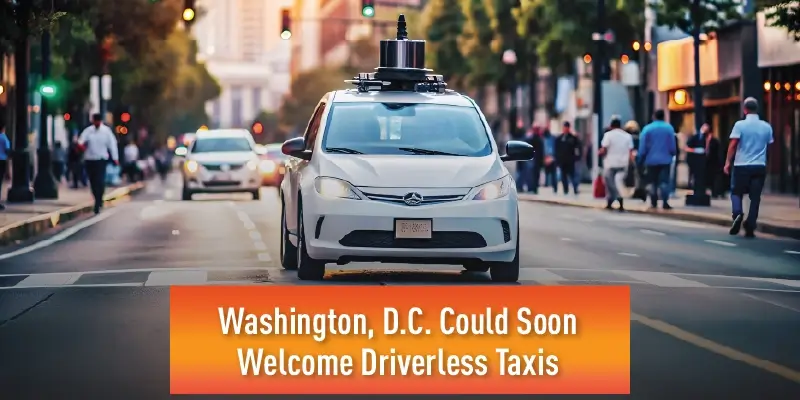
Washington, D.C. is no stranger to transportation innovation, but the next evolution of urban mobility may be its most transformative yet. As autonomous vehicle technology continues to advance across the United States, the nation’s capital is preparing for a future where ride-hailing services could operate without a human driver behind the wheel. What was once considered a futuristic concept is steadily moving toward reality, with driverless taxis expected to become part of the city’s transportation landscape in the coming years.
Across the United States, autonomous vehicle technology is moving from controlled testing environments to real-world urban deployment. Cities such as Phoenix, San Francisco, and Austin have already become proving grounds for driverless ride-hailing services. Now, Washington, D.C. is preparing to take its place on that list.
The arrival of autonomous taxis in Washington, D.C. is about far more than introducing a new transportation service. It represents a critical test of whether self-driving technology is ready to operate in one of the most complex urban environments in the United States. Unlike many cities where robotaxis currently operate, Washington presents a unique combination of historic street layouts, dense traffic, federal security zones, unpredictable road closures, and millions of annual visitors unfamiliar with local roads.
As lawmakers debate regulations and autonomous vehicle developers continue extensive mapping operations across the District, one question remains at the center of the conversation: Can driverless taxis safely and efficiently navigate Washington’s complex road network?
Why Washington, D.C. Is Different from Every Other Robotaxi City?
The conversation around robotaxis often focuses on technology. However, the environment in which that technology operates is equally important.
Locations such as Dupont Circle, Washington Circle, and Scott Circle are well known for confusing traffic movements. Drivers must simultaneously monitor merging vehicles, pedestrians, cyclists, buses, and changing traffic signals. For autonomous vehicles, these environments require constant processing of enormous amounts of data in real time.
Beyond roadway design, Washington must also accommodate federal operations, diplomatic activity, public demonstrations, and security measures that can dramatically alter traffic conditions without warning. Streets may close temporarily due to presidential motorcades, international summits, or public events. Autonomous vehicles must be capable of recognizing these changes instantly and adjusting routes safely.
Few American cities present the same level of complexity for self-driving technology as Washington, where infrastructure challenges and constantly changing road conditions intersect daily.
The Road to a Driverless Taxi Service in Washington
Before passengers can begin riding in autonomous taxis, companies must complete a lengthy process involving mapping, testing, safety validation, and regulatory approval.
The foundation of every successful robotaxi program is an exceptionally detailed understanding of the road environment. To achieve that, autonomous vehicle developers have spent months surveying Washington’s streets and transforming them into sophisticated digital maps capable of guiding self-driving systems through complex urban conditions.
These maps capture information about lane markings, traffic signals, road geometry, curb locations, construction zones, and countless other roadway details. The process is essential because autonomous vehicles rely on multiple layers of environmental understanding. While onboard sensors help vehicles perceive their surroundings in real time, high-definition maps provide an additional level of accuracy that improves navigation and decision-making.
The path toward deployment is expected to follow several stages.
| Deployment Stage | Purpose |
|---|---|
| Mapping and Testing | Create detailed digital maps and validate vehicle performance |
| Regulatory Approval | Establish legal frameworks for commercial operation |
| Pilot Passenger Programs | Introduce limited driverless rides to selected users |
| Commercial Launch | Open autonomous ride-hailing services to the public |
| Regional Expansion | Extend operations into surrounding commuter corridors |
While timelines remain dependent on regulatory developments, momentum continues to build as both policymakers and technology companies explore opportunities for deployment.
How Autonomous Taxis Navigate Complex Urban Streets?
Unlike human drivers who rely primarily on eyesight, autonomous vehicles combine information from multiple systems simultaneously. Cameras identify traffic lights, lane markings, pedestrians, and road signs. Radar tracks moving objects and measures speed. LiDAR systems create detailed three-dimensional models of the surrounding environment. Artificial intelligence software then analyzes all of this information to determine the safest course of action.
This capability becomes particularly important in Washington, where traffic conditions can change rapidly. A cyclist entering an intersection, a pedestrian stepping into a crosswalk, or a delivery truck blocking a lane can all require immediate adjustments. The vehicle’s software must not only detect these events but also predict how nearby road users are likely to behave next.
This predictive capability represents one of the most significant advancements in modern autonomous vehicle technology.
The Safety Argument Behind Robotaxis
Supporters of autonomous transportation frequently point to safety as the industry’s most compelling benefit. Traffic crashes remain a significant public safety issue across the United States. Federal transportation data consistently shows that human error contributes to the vast majority of serious roadway accidents. Distraction, fatigue, speeding, impaired driving, and poor judgment continue to be leading factors in collision rates nationwide.
Autonomous vehicles aim to address many of these challenges by removing human limitations from the driving process. Unlike people, self-driving systems do not become tired after long hours behind the wheel. They do not send text messages while driving, become emotionally distracted, or drive under the influence. Instead, they maintain continuous awareness of their surroundings and react according to programmed safety protocols.
This does not mean autonomous vehicles are perfect. Like any emerging technology, they face ongoing challenges and require continuous improvement. However, proponents argue that reducing the role of human error could ultimately lead to safer roads and fewer traffic-related injuries. Washington’s dense traffic conditions may provide one of the most meaningful environments for evaluating these safety claims.
What Riding in a Robotaxi Will Actually Feel Like?
For passengers, the experience may be less dramatic than many people expect. The process will likely resemble today’s ride-hailing services in many ways. Riders will request transportation through a smartphone application, select a pickup location, and receive updates regarding vehicle arrival.
Once the autonomous taxi arrives, passengers will verify their trip and enter the vehicle. Interior touchscreens may allow riders to adjust climate settings, view route information, or contact customer support if necessary.
The most noticeable difference will be the absence of a human driver. During the journey, passengers will have the opportunity to observe the vehicle navigating intersections, responding to traffic signals, and interacting with surrounding road users on its own.
Early adopters in other cities often describe the experience as surprisingly normal after the first few minutes. Once the novelty wears off, many passengers focus less on the technology and more on reaching their destination efficiently.
The Impact on Washington Commuters
Washington’s transportation network serves residents from Maryland, Virginia, and the District itself. Every day, thousands of commuters travel into the city for work, education, healthcare, and government services.
Autonomous ride-hailing services could help address transportation gaps by providing additional mobility options, particularly during periods when traditional transit options are limited.
For older adults, individuals with mobility challenges, and residents without access to personal vehicles, robotaxis could expand transportation accessibility. They may also improve first-mile and last-mile connections between homes, workplaces, and Metro stations. Rather than replacing public transportation, many transportation experts envision autonomous vehicles complementing existing transit systems.
Challenges That Could Slow Adoption
Despite growing excitement, several obstacles remain before autonomous taxis become commonplace in Washington. Regulatory approval remains one of the largest hurdles. Policymakers must establish clear standards governing safety, insurance, liability, data privacy, and operational oversight.
Public trust is another critical factor. Many Americans remain cautious about fully autonomous vehicles, particularly when no safety driver is present. Building confidence will require transparent safety reporting and consistent operational performance.
Weather conditions, construction zones, and unusual traffic scenarios also continue to present technical challenges. While autonomous systems have improved significantly in recent years, developers are still working to address rare situations that require complex decision-making.
Final Thoughts: A Glimpse into the Future of Urban Mobility
Success in the nation’s capital could influence how autonomous transportation expands across other major metropolitan areas. If driverless vehicles can safely navigate Washington’s unusual street design, federal security zones, and dense traffic patterns, it may strengthen confidence in broader deployments nationwide.
The city offers a uniquely demanding environment that tests nearly every aspect of autonomous driving technology. In many ways, Washington could become a benchmark for evaluating whether self-driving transportation is ready for large-scale adoption.
For commuters, the shift may eventually feel as transformative as the introduction of ride-sharing apps more than a decade ago. What seems innovative today could become an ordinary part of daily life tomorrow.
Also Read: Best Electric SUVs Under $50K in 2026
Frequently Asked Questions
When will autonomous taxis be available to the public in Washington, D.C.?
Autonomous taxi services in Washington, D.C. are currently progressing through testing and regulatory stages. Public availability will depend on final approvals and operational permits before commercial deployment begins.
Are driverless taxis in Washington, D.C. safe?
Autonomous taxis use advanced technologies including LiDAR, radar, cameras, and artificial intelligence to monitor road conditions continuously. Their goal is to reduce crashes caused by human error, though ongoing testing remains essential.
How will robotaxis handle Washington's traffic circles and road closures?
Modern autonomous vehicle technology uses real-time mapping, environmental sensing, and route optimization systems to adapt to changing traffic conditions, temporary road closures, security zones, and complex intersections throughout Washington.
Looking for practical driving hacks, maintenance tips, vehicle technology updates, and the latest automotive trends? Just have a look at Mr. Leecar for expert insights on U.S. car trends, automotive news, and upcoming vehicle launches.

