

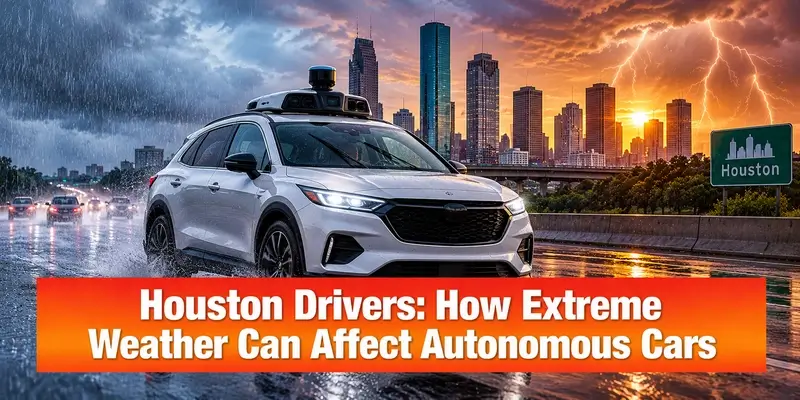
Houston’s climate makes that question particularly important. At Houston’s George Bush Intercontinental Airport, the National Weather Service recorded 101°F as the highest temperature in 2025, while the city recorded 14 days with at least one inch of rain at Houston Hobby Airport. Houston’s long-term climate data also shows an annual normal precipitation of about 51.84 inches at IAH, with a historical one-day rainfall record of 16.07 inches.
For an autonomous vehicle, it can change the quality of the data used to make every driving decision.
That distinction matters as autonomous ride-hailing expands in Houston. Waymo began public autonomous service in Houston in February 2026 and opened the service to anyone in the city in August 2026.
How Rain Can Affect Autonomous Vehicle Safety
One of the biggest challenges for autonomous driving in Houston is not ordinary rain. It is the sudden, extremely heavy rainfall that can overwhelm visibility in a matter of seconds.
Autonomous vehicles typically combine multiple sensing technologies, including cameras, radar and LiDAR, with detailed maps and onboard computing. Each technology sees the environment differently, which is why sensor fusion is so important.
Cameras lose visual clarity
Cameras are particularly valuable for recognizing visual information such as traffic lights, signs, lane markings, vehicles, and pedestrians. But Houston’s heavy rain can cover a camera’s field of view with water droplets. Spray from nearby traffic creates another layer of interference. The vehicle therefore has a more difficult perception problem where the road has not disappeared, but the visual evidence describing it has become less reliable.
LiDAR can also be affected
LiDAR sends rapid laser pulses into the surroundings and measures their reflections to create a detailed 3D view of the vehicle’s environment. It can provide valuable information about the position of vehicles, objects, and other road features, but precipitation can interfere with its measurements. NHTSA notes that LiDAR performance can be significantly degraded by rain, fog, sleet and snow.
Heavy precipitation can therefore introduce unwanted returns or reduce the useful range of the sensor. That does not necessarily mean an autonomous car suddenly becomes “blind.” Instead, the vehicle’s perception system has to determine how much confidence it should place in the available sensor data.
Radar provides another layer of information
Radar measures objects using radio waves rather than optical images. That makes it valuable when visibility deteriorates. However, radar is not an unlimited solution to severe weather. Heavy precipitation can affect sensing performance, while road spray, reflections and complex traffic environments can make interpretation more difficult.
The important point is that autonomous driving in rain depends on redundancy rather than one sensor doing all the work.
Houston Flooding Creates a Bigger Problem Than Poor Visibility
Houston drivers are already familiar with the dangers of water covering lanes, intersections and underpasses. Texas transportation officials warn motorists never to drive through flooded roads because water can hide debris, damaged pavement and other hazards. TxDOT also notes that just six inches of fast-moving water can cause a motorist to lose control.
For autonomous cars, flooded roads create an additional perception problem. A lane marking that is normally an important navigation reference can disappear beneath water. The surface itself can become highly reflective, making it harder for cameras to distinguish road texture, lane boundaries, and standing water. This is where autonomous vehicle safety becomes less about simply seeing and more about knowing when not to continue.
Why Puddles and Reflections Matter More
Water can reflect headlights, traffic signals, buildings and other objects. During a nighttime storm, the combination of wet pavement, headlights and road spray can produce a visually complicated environment. The challenge becomes even greater when normal road markings are partially hidden.
This is one reason autonomous driving systems cannot rely exclusively on a pre-mapped picture of a street. Maps provide valuable information, but the vehicle still needs real-time perception to understand what has changed since that map was created.
Houston’s weather creates plenty of opportunities for those changes. A familiar section of Allen Parkway, Memorial Drive or another major roadway can look substantially different after intense rainfall. Water can cover pavement markings, debris can appear in travel lanes and temporary closures can alter the expected route. The map may describe the road. The sensors have to determine what the road looks like today.
Heat Is a Different Kind of Autonomous-Vehicle Test
Houston’s weather challenge does not end when the rain stops. Heat places sustained demands on the vehicle’s electronics, sensors, battery systems and thermal-management hardware.
Houston’s 2025 climate report illustrates the scale of the environment. At Houston Hobby Airport, the average maximum temperature for the year was 82.0°F, with 136 days reaching at least 90°F. The site also recorded 42 days classified as having heavy rain and 71 thunderstorm days. For an autonomous vehicle operating for long periods, that means hardware must continue working reliably while exposed to heat, humidity, and direct sunlight.
Sensor and computing temperatures matter
Autonomous vehicles process enormous quantities of sensor information in real time. Cameras, radar, LiDAR and onboard computers all have operating-temperature requirements. Maintaining those components within their intended thermal ranges requires carefully engineered cooling systems.
If computing hardware becomes thermally constrained, processing performance can potentially be affected. This is why thermal management is not simply an electric-vehicle battery issue. For autonomous cars, it is also part of perception and computing reliability.
Heat can also change the visual environment
Houston’s hot pavement can create shimmering air above wet or dark road surfaces. For a human driver, that effect may be little more than an annoyance. For computer vision systems, atmospheric distortion, glare, and rapidly changing light conditions add another layer of complexity.
The result is a broader engineering challenge: autonomous vehicles must perform not just in controlled test conditions, but across the messy range of real-world environments drivers encounter every day.
What Houston's Autonomous Future Could Teach the Rest of the U.S.
Houston is more than another city on an autonomous-vehicle deployment map. Its combination of heavy rainfall, thunderstorms, heat, humidity, sprawling highways and flood-prone road conditions provides a demanding environment for testing how autonomous technology responds to changing conditions.
A system that can reliably handle Houston’s rain may provide useful insights for autonomous driving in other Gulf Coast cities. A vehicle designed to manage extreme heat may also face similar requirements in Phoenix, Las Vegas or other hot-weather markets.
Likewise, lessons from flooded roadways could influence how autonomous systems approach severe-weather events in other low-lying metropolitan areas.
Waymo’s expansion into Houston is therefore significant not only because more people can now experience fully autonomous rides, but because commercial operation places the technology in the unpredictable conditions of everyday city driving.
What Should Houston Drivers Know About Autonomous Cars in Extreme Weather?
The arrival of autonomous vehicles does not eliminate the importance of weather awareness. Whether you are driving your own car or sharing the road with an autonomous vehicle, heavy rain still means reduced visibility, longer stopping distances and potentially hazardous standing water.
Houston drivers should never assume that an autonomous vehicle will attempt to cross a flooded road simply because its sensors can detect the water. The same basic rule applies to every vehicle on the road where floodwater covers the roadway do not drive through it.
For autonomous technology, the larger lesson is that reliable transportation requires more than sophisticated artificial intelligence. It requires accurate sensing, redundant systems, strong thermal management, real-time decision-making, and clearly defined limits. Houston’s weather puts all of those capabilities to the test.
Also Read: Best SUVs for Families in Houston
Frequently Asked Questions
Can autonomous cars drive safely in Houston's heavy rain?
Autonomous cars can be designed to operate in rain using sensor fusion, but torrential rain can degrade camera and LiDAR performance and complicate radar perception. Autonomous systems therefore need weather-related operating limits and appropriate fallback behavior rather than relying on one sensor.
How does Houston flooding affect autonomous vehicle safety?
Houston flooding can obscure lane markings, change roadway conditions and hide hazards beneath the water. TxDOT warns that flooded roads may contain debris, damaged pavement and other dangers, and advises drivers not to enter flooded roadways.
Does extreme Texas heat affect autonomous driving technology?
Yes. Extreme Texas heat can place additional thermal demands on autonomous vehicle sensors, computers and other electronic systems.
Final Takeaway
Houston may ultimately prove that the future of autonomous driving is not just about teaching cars to recognize roads, vehicles, and pedestrians. It is about teaching them to understand when the environment itself has become unreliable. Rain, flooding, heat and changing road conditions will continue to challenge autonomous vehicles because they challenge the basic quality of the information those vehicles use to make decisions.
If you have a car problem or want more practical car tips, check out Lee Car Experts for U.S.-based car trends, automotive news, vehicle launches, and smarter driving insights.


