

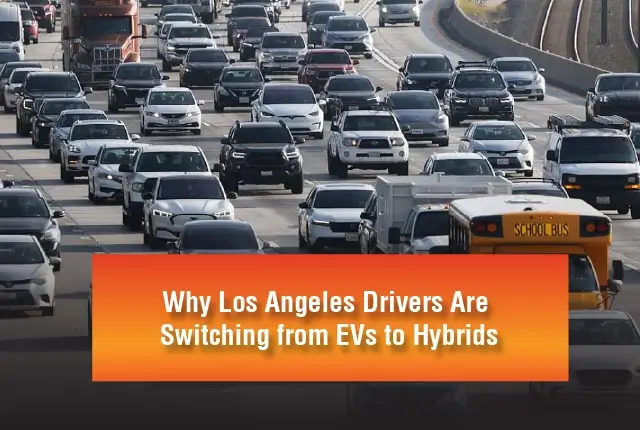
Not long ago, owning an electric vehicle in Los Angeles felt like a glimpse into the future. Across Southern California, from Santa Monica to Silicon Beach, EVs emerged as a preferred choice for drivers seeking cleaner transportation and relief from rising gas prices. For many drivers, going electric wasn’t simply about transportation also it was a lifestyle statement.
Today, a significant transformation is taking place on Southern California’s roads.
While electric vehicles remain a major part of California’s automotive landscape, an increasing number of drivers are turning their attention to hybrid models instead. The change is visible everywhere, from dealership lots and freeway commutes to new vehicle registration data. Buyers who once viewed fully electric vehicles as the obvious next step are now choosing gas-electric hybrids that offer many of the same environmental benefits without some of the practical challenges that continue to frustrate everyday commuters.
The reason isn’t a rejection of clean transportation. Rather, it reflects the realities of living and driving in one of the largest metropolitan regions in the United States. Los Angeles drivers face unique challenges that many other markets simply don’t experience. Lengthy commutes, charging challenges, and rising ownership costs are prompting more drivers to focus on convenience, efficiency, and overall value.
California's EV Momentum Is Facing a Reality Check
California remains the undisputed leader in electric vehicle adoption, accounting for a significant share of EV sales nationwide. However, recent market trends suggest that growth is no longer moving in a straight line. While electric vehicles continue to attract buyers, hybrid vehicles are capturing increasing attention from consumers who want a more practical solution for daily transportation.
Industry data shows hybrid registrations growing steadily as some consumers reconsider the long-term realities of EV ownership. This shift is particularly noticeable in Los Angeles, where driving conditions differ dramatically from those in many other regions of the country.
Unlike suburban communities where homeowners can conveniently charge overnight in private garages, much of Los Angeles consists of apartment buildings, multi-family housing, and older residential neighborhoods that were never designed with EV charging infrastructure in mind. For these residents, the transition to electric mobility is often far more complicated than advertisements suggest.
Rather than abandoning fuel-efficient transportation altogether, many drivers are choosing hybrids as a compromise that delivers meaningful environmental benefits without introducing new inconveniences into their daily routines.
The Charging Problem Nobody Talks About
One of the biggest challenges facing EV adoption in Los Angeles is not battery range but charging accessibility.
Automakers have largely solved range anxiety. Many modern electric vehicles now exceed 300 miles on a single charge, more than enough for most daily driving needs. However, having sufficient range means little if charging remains difficult or inconvenient.
For residents living in apartments across neighborhoods such as Koreatown, Hollywood, Downtown Los Angeles, and Long Beach, home charging is often unavailable. Public charging stations become the primary option, creating a dependency that can quickly become frustrating.
Drivers frequently encounter occupied chargers, equipment malfunctions, software connectivity issues, and lengthy wait times during peak hours.While the charging infrastructure may appear extensive on paper, many drivers encounter a different reality in everyday use.
For many Angelenos, the convenience promised by EV ownership is being replaced by a new form of stress. Instead of worrying about battery range, they are worrying about whether an available charger will be waiting when they need one.
Hybrid vehicles eliminate that concern. Drivers still benefit from electric assistance and improved efficiency, but they retain the flexibility of refueling at any gas station within minutes.
Why LA Traffic Favors Hybrid Technology?
The region’s infamous traffic congestion creates an environment where vehicles spend considerable time crawling through crowded freeways rather than cruising at highway speeds. Ironically, these conditions play directly into the strengths of modern hybrid technology.
Modern hybrid vehicles perform exceptionally well in city driving, where constant braking and acceleration allow them to maximize fuel efficiency. Through regenerative braking, hybrids capture energy that would normally be lost during deceleration and use it to recharge their batteries. Every red light, traffic jam, and slow-moving freeway becomes an opportunity to improve efficiency.
For drivers commuting daily between Orange County and Downtown Los Angeles or navigating the heavily congested 405 corridor, these savings add up quickly.
Models such as the Toyota Camry Hybrid and Honda Accord Hybrid continue to attract commuters by delivering impressive fuel efficiency, often approaching or exceeding 50 MPG in everyday driving conditions. For households facing California’s high fuel prices, that efficiency translates into substantial annual savings.
| Popular Hybrid Model | Estimated Combined MPG | Why It Appeals to LA Commuters |
|---|---|---|
| Toyota Camry Hybrid | Up to 51 MPG | Strong fuel economy and comfortable highway cruising |
| Honda Accord Hybrid | Up to 48 MPG | Spacious interior and excellent commuter efficiency |
| Toyota Prius | Up to 57 MPG | Industry-leading fuel efficiency |
| Hyundai Elantra Hybrid | Up to 54 MPG | Affordable ownership costs |
| Toyota Corolla Hybrid | Up to 50 MPG | Compact size and outstanding everyday economy |
The Hidden Costs Changing Consumer Decisions
Vehicle purchase prices often dominate headlines, but ownership costs extend far beyond the sticker price.
Insurance has emerged as one of the most significant factors influencing buying decisions in California. While premiums have risen across the automotive industry, electric vehicles often face additional cost pressures due to expensive battery systems, specialized repair procedures, and limited repair networks.
A relatively minor collision can result in repair estimates that surprise many owners. In some cases, battery-related concerns dramatically increase repair costs, contributing to higher insurance payouts and rising premiums.
Los Angeles drivers are becoming increasingly aware of these long-term ownership realities. Hybrids, by comparing, benefit from decades of technological refinement. Repair networks are widespread, replacement parts are readily available, and technicians familiar with hybrid systems can be found throughout Southern California.
For consumers evaluating five- to ten-year ownership costs, these factors can make hybrids appear considerably less risky.
Apartment Living Is Reshaping the Vehicle Preferences
Housing patterns play a larger role in vehicle adoption than many industry observers acknowledge. Los Angeles County is home to millions of residents living in apartments, condominiums, and multi-unit housing developments. While EV ownership works exceptionally well for drivers with dedicated home charging, the experience can be very different for renters.
Installing charging infrastructure in older apartment complexes often requires significant investment and coordination among property owners, utility companies, and local authorities. As a result, many renters remain dependent on public charging solutions.
Hybrid vehicles bypass this challenge entirely. For renters seeking lower fuel costs and reduced emissions, hybrids deliver many of the advantages associated with electrification without requiring access to charging infrastructure. This flexibility has become one of the strongest selling points driving hybrid demand throughout Southern California.
California Drivers Are Becoming More Practical
The growing popularity of hybrid vehicles does not suggest that Californians are abandoning environmental goals. Instead, consumers appear to be prioritizing practicality alongside sustainability. Many drivers still want to reduce fuel consumption, lower emissions, and support cleaner transportation technologies. However, they also want vehicles that fit seamlessly into their daily lives.
Hybrid vehicles increasingly represent that balance. They offer measurable environmental benefits, impressive fuel economy, lower ownership complexity, and greater flexibility than fully electric alternatives for many households. In a region where commuting can already consume several hours each week, convenience carries enormous value.
What does this mean for the Future of EV Adoption?
The current hybrid boom should not be interpreted as a setback for electric vehicles. EV technology continues to improve rapidly, and charging infrastructure investments remain substantial. As public charging networks expand and residential charging becomes more accessible, electric vehicles will likely regain momentum among many consumer groups.
However, the Los Angeles market highlights an important lesson for automakers and policymakers alike: adoption depends on more than technology alone. Infrastructure, affordability, convenience, and local living conditions all influence purchasing decisions. For now, hybrid vehicles are successfully addressing many of the concerns that continue to slow EV adoption among mainstream consumers.
Final Thoughts: Pragmatism Is Winning the Commute
Los Angeles drivers are not rejecting the future. They are choosing the transportation solution that works best for their present.
For many households, hybrid vehicles offer the ideal balance between efficiency, affordability, flexibility, and environmental responsibility. They reduce fuel consumption without introducing dependence on public charging infrastructure, making them particularly attractive in a city defined by congestion, long commutes, and diverse housing situations.
As California continues its transition toward cleaner mobility, hybrids are proving that innovation is not always about choosing the newest technology. Sometimes, it’s about choosing the technology that fits real life.
Frequently Asked Questions
In the electric vs hybrid cars debate, which is better for Los Angeles drivers?
For many Los Angeles drivers, hybrids currently offer greater convenience because they provide exceptional fuel economy without relying on public charging infrastructure. EVs remain a strong option for homeowners with reliable charging access.
Why are hybrid vehicles in Los Angeles becoming more popular?
Hybrid vehicles are gaining popularity due to charging accessibility challenges, rising EV insurance costs, apartment living limitations, and the need for practical solutions for long daily commutes.
What are the best hybrid cars for city driving in California?
Popular choices include the Toyota Camry Hybrid, Toyota Prius, Honda Accord Hybrid, Hyundai Elantra Hybrid, and Toyota Corolla Hybrid. These vehicles excel in stop-and-go traffic and deliver outstanding fuel efficiency.
For the latest U.S.-based car trends, industry insights, vehicle launches, EV updates, and automotive news, just have a look at Mr.Leecar. Stay informed about the latest developments, and connect with experts who follow the rapidly evolving automotive landscape every day.


