Boulder, Colorado, is known for its outdoor lifestyle, sustainability initiatives, and growing adoption of electric vehicles. For EV drivers, that combination makes reliable charging infrastructure an important part of everyday travel. Whether you live in Boulder, commute to the city, attend CU Boulder, or are passing through on a longer Colorado road trip, knowing where and how to charge can make your journey considerably easier.
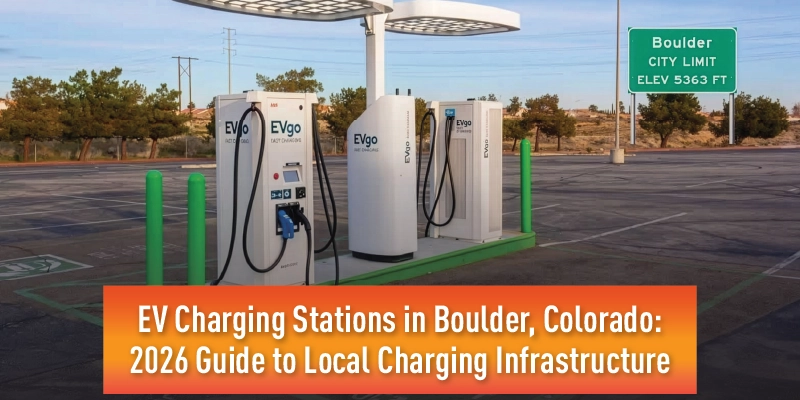
Drivers can find charging at downtown parking garages, recreation facilities, parks, shopping areas, and private charging networks. Boulder’s municipal charging network extends across multiple locations, with public EV chargers available at downtown garages, parks, and other city facilities.
However, finding a charger is only the first step. Charging speed, connector compatibility, pricing, parking limits, and your planned driving distance can all affect which station makes the most sense. This blog post provides an overview of Boulder’s expanding EV charging network, helping drivers understand available options and plan their charging stops effectively.
Understanding Boulder’s EV Charging Network
Boulder’s charging infrastructure is designed around the way people actually use the city. Instead of depending entirely on large charging hubs, public chargers are positioned at places where drivers naturally spend time.
Downtown garages are useful for commuters and visitors who want to charge while working, shopping, or dining. Recreation centers and parks provide another option for drivers whose vehicles will already be parked for an extended period. Fast-charging stations are better suited to situations where drivers need to replenish their battery in a shorter amount of time.
The most important distinction for drivers is between Level 2 charging and DC fast charging. Level 2 chargers use higher-voltage electrical service than a standard household outlet and are generally intended for longer parking periods. They are well suited to workplaces, garages, shopping destinations, and recreation facilities.
Downtown Boulder: Charging Near Pearl Street
Downtown Boulder is one of the more convenient areas for combining charging with other activities. Multiple municipal parking garages in downtown Boulder are equipped with EV charging facilities, providing convenient access for drivers visiting the area. This makes the garage useful for different types of trips. Someone spending several hours downtown may prefer Level 2 charging, while a driver who needs additional range before leaving the area may choose the faster option.
Free Public EV Charging in Boulder
Free charging can be useful, but it should be viewed as destination charging rather than guaranteed fuel-free travel. Several Boulder locations provide free Level 2 charging, allowing drivers to add range while they are already visiting the area.
However, free charging does not necessarily mean unlimited access. EV drivers should always check posted parking restrictions and current city policies before leaving their vehicle connected for an extended period.
What Will You Pay to Charge an EV in Boulder?
There is no single rate for public EV chargers in Boulder. Pricing depends on the charging network, location, charging speed, and billing structure. The City of Boulder provides a useful example through its municipal charging locations:
| Boulder Charging Location | Charger Type | Current Charging Structure |
| 15th & Pearl Garage | Level 2 | $1/hour for first 2 hours; $2.50/hour afterward |
| 15th & Pearl Garage | Level 3 | $0.45/kWh for first 30 minutes; $0.25/minute afterward |
| Chautauqua Park | Level 2 | Free |
| Boulder Reservoir | Level 2 | Free |
| Valmont Dog Park | Level 2 | Free |
| Recreation Centers | Level 2 | $1/hour for first 2 hours; $2.50/hour afterward |
Charging rates and policies can change, so drivers should check the latest pricing before starting a session. It is also important to account for parking fees, as some Boulder facilities charge separately for parking and electricity. Looking at the combined cost provides a more accurate picture of what a charging stop will actually cost.
When Is the Best Time to Charge an EV in Boulder?
For EV owners, charging at the right time can improve convenience and potentially reduce electricity costs. However, the answer depends on whether you are charging at home or using a public station.
Home charging can be scheduled around your residential electricity plan. If your utility rate is lower during certain periods, charging overnight or during another lower-cost period may make sense.
Public charging works differently. Charging networks set their own prices, and a station may bill by kilowatt-hour, minute, session, or another method. Therefore, drivers should not automatically assume that a public fast charger will be cheaper at night.
For most Boulder EV owners, a practical strategy is to use home charging for routine driving, public Level 2 charging when the vehicle is already parked, and DC fast charging when saving time is the priority.
Boulder’s Charging Landscape Is Changing
Boulder is not simply adding charging stations; it is also adapting how existing infrastructure is managed. As EV ownership increases, a charging space becomes more valuable. A stall occupied by a fully charged vehicle is unavailable to another driver who may need the electricity to get home or continue a trip. This is one reason Boulder has introduced time limits and charging fees at some public locations.
For drivers, the change means that EV charging should be treated differently from ordinary parking. Plugging in does not automatically give you unlimited access to a space. A more efficient charging culture benefits everyone. Efficient use of charging spaces allows more EVs to share existing infrastructure as Boulder’s electric vehicle population continues to grow.
Charging Before a Colorado Road Trip
Boulder is well positioned for trips across Colorado, but EV drivers should plan beyond the city limits. If you are heading toward Denver, the mountain communities, or another Front Range destination, check your expected range before leaving Boulder.
A good road-trip strategy is to leave Boulder with enough charge to reach your next reliable charging opportunity with a reasonable buffer. You do not necessarily need to charge to 100% at a DC fast charger. For many EVs, charging slows considerably as the battery approaches a high state of charge. On a road trip, stopping for enough energy to comfortably reach the next charger can sometimes be more efficient than waiting for a full battery.
The NACS Factor in 2026
Connector compatibility has become an increasingly important part of EV charging in the United States. Many newer EVs are adopting NACS, while older vehicles may use CCS. Some vehicles can access additional charging networks with an approved adapter.
For Boulder drivers, this means your charging plan should account for your vehicle’s actual connector configuration, rather than simply searching for a fast charger near me. If you drive a non-Tesla EV and plan to use a Tesla Supercharger, verify whether the specific station supports your vehicle and whether an adapter is required. This small check can prevent a frustrating detour.
How to Avoid Common Charging Mistakes
The easiest way to improve your EV charging experience is to avoid treating every charger the same.
A free Level 2 charger at a park is valuable when you are already spending two hours there. It is not necessarily useful if you need to leave town in 20 minutes.
Similarly, a high-powered DC fast charger is convenient for road trips but may be unnecessarily expensive for routine overnight charging.
Drivers should also pay attention to idle or overstay policies. Once the vehicle has finished charging, moving it allows another driver to use the station.
Charging etiquette matters even more in busy areas where demand can exceed the number of available ports.
Final Thoughts
Boulder offers EV drivers a mix of Level 2 destination charging, municipal garage charging, free public charging, and DC fast-charging options. The key to using the network efficiently is not simply finding a charger but choosing the right charger for your vehicle, schedule, destination, and budget. Boulder’s EV infrastructure is likely to remain an evolving part of the city’s transportation system.
As more drivers switch to electric vehicles, the emphasis will increasingly move from simply installing chargers to improving accessibility, reliability, charging speed, and equitable access. Charging apps can help identify stations, but drivers should still verify information directly with the charging operator whenever possible. Prices, station availability, connector compatibility, and operating policies can change.
Also Read: Best Electric SUVs Under $50K in 2026
Frequently Asked Questions
Where can I find EV charging stations in Boulder, Colorado?
EV charging stations in Boulder, Colorado are available at downtown parking garages, recreation facilities, parks, shopping areas, and private charging locations. The City of Boulder lists charging at locations including 15th & Pearl Garage, Chautauqua Park, Boulder Reservoir, and Valmont Dog Park.
Are there free public EV chargers in Boulder?
Yes. Some public EV chargers in Boulder offer free Level 2 charging, including locations such as Chautauqua Park, Boulder Reservoir, and Valmont Dog Park. Availability and parking restrictions can change, so drivers should check current city information before visiting.
How much does fast charging in Boulder cost?
The cost of fast charging in Boulder varies by network and location. Some chargers use per-kWh pricing, while others may combine energy and time-based charges. Drivers should check the current rate through the charging network’s app before beginning a session.
For more EV charging hacks, practical car tips, and the latest US-based car trends, car news, and vehicle launches, just have a look at Mr.Lee car experts.