

The next major battle in the automotive industry is not being fought over horsepower, towing capacity, or electric vehicle range. It is being fought over software, data, and national security.
As modern vehicles become increasingly connected, cars are evolving into sophisticated digital platforms capable of collecting, processing, and transmitting enormous amounts of information. Features that consumers now rely on every day such as smartphone integration, remote vehicle access, over-the-air software updates, cloud navigation, and advanced driver-assistance systems depend on complex software ecosystems operating behind the scenes.
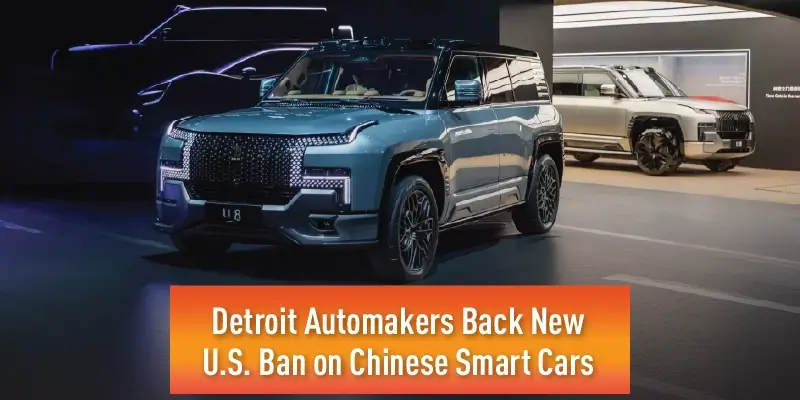
Those concerns have now led to one of the most significant automotive policy developments in recent years. Detroit automakers are backing a federal U.S. ban on Chinese smart cars and connected vehicle technologies, arguing that the issue goes far beyond trade competition. Supporters of the restrictions believe they are necessary to protect national security, safeguard consumer privacy, strengthen domestic manufacturing, and secure the future of America’s automotive industry.
As the automotive industry moves deeper into the software-defined era, understanding why Detroit supports these restrictions offers valuable insight into where the future of transportation is headed.
Why Do Detroit Automakers Support the Chinese Smart Car Ban?
Detroit’s support for the Chinese connected cars ban is driven by a combination of security concerns and economic realities.
Over the past decade, vehicles have become increasingly dependent on software and connectivity. Modern cars constantly communicate with cloud platforms, navigation services, smartphone applications, and manufacturer servers. This connectivity provides convenience and safety benefits, but it also creates new risks.
Meanwhile, Detroit’s leading automakers have committed billions of dollars to expanding electric vehicle production, advancing battery technology, developing autonomous driving systems, and strengthening software capabilities. Industry leaders argue that heavily subsidized Chinese EV imports could undermine domestic investments before American manufacturers fully scale their next-generation vehicle programs.
What the U.S. Ban on Chinese Car Software Actually Covers?
One common misconception is that the restrictions target only vehicles manufactured in China. In reality, the regulations focus primarily on connected vehicle technology.
The rules introduced by the U.S. The Department of Commerce’s Bureau of Industry and Security are designed to limit the use of software and hardware linked to foreign adversaries in critical vehicle systems.
| Restriction Area | Effective Timeline | What Is Covered |
|---|---|---|
| Connected Vehicle Software | Model Year 2027 | Vehicle Connectivity Systems, Automated Driving Systems, telematics software, cloud-connected vehicle applications |
| Connected Vehicle Hardware | Model Year 2030 | Cellular modules, telematics control units, satellite communication equipment, antennas, receivers, and related connectivity hardware |
The goal is to reduce potential security risks while encouraging the development of domestic alternatives that align with U.S. cybersecurity standards.
Why Connected Vehicle Technology Has Become a National Security Issue?
The average driver may not think of a vehicle as a data-generating device, yet modern automobiles collect and process an enormous amount of information.
Connected vehicles can gather:
- GPS location data
- Navigation history
- Vehicle diagnostics
- Driver behavior information
- Smartphone connectivity data
- Camera and sensor inputs
- Remote access activity
As vehicles become more advanced, the amount of information they handle continues to increase. Features such as autonomous driving, predictive maintenance, remote software updates, and connected infotainment systems all rely on continuous data exchange.
Government officials argue that protecting this information is becoming as important as protecting personal computers, smartphones, and financial networks. The concern is not limited to individual privacy. Regulators also worry about the potential risks associated with large-scale access to transportation data and infrastructure.
The Rise of Software-Defined Vehicles
The automotive industry is undergoing one of its most dramatic transformations since the invention of the assembly line. Traditionally, vehicle performance was determined largely by mechanical engineering. Today, software plays an equally important role. Everything from acceleration response and battery management to safety features and navigation systems depends on sophisticated code.
This shift has fundamentally changed the competitive landscape. Automakers are no longer competing solely on manufacturing efficiency or engine performance. They are also competing on software capabilities, cybersecurity protections, connectivity features, and digital services.
As software becomes the backbone of transportation, governments are paying closer attention to where that software is developed and who maintains it.
Also Read: Best Electric SUVs Under $50K in 2026
How the Ban Could Reshape the U.S. Automotive Industry?
Automakers are reviewing supply chains, auditing software systems, and identifying components that may require replacement before future regulations take effect. Many companies have accelerated efforts to localize production and reduce reliance on overseas suppliers. Industry leaders have increasingly prioritized localized production as manufacturers seek greater stability and control over critical vehicle components.
The push toward localization is creating new opportunities for American manufacturing, particularly in regions with established automotive expertise. States such as Michigan, Ohio, Indiana, Kentucky, and Tennessee are seeing increased investment in battery plants, electronics manufacturing, software development centers, and advanced vehicle technology facilities.
These investments could strengthen domestic supply chains while supporting long-term job growth in the automotive sector.
What the Ban Means for Chinese EV Imports
Chinese automakers have rapidly expanded their global footprint through competitive pricing, advanced battery technology, and strong government support. In many international markets, Chinese electric vehicles have gained attention for offering high levels of technology at attractive price points.
The United States, however, is taking a more restrictive approach. Beyond tariffs and trade policies, the connected vehicle restrictions introduce additional compliance requirements that could make it more difficult for Chinese automakers to enter the U.S. market.
Vehicles incorporating prohibited connectivity technologies could encounter stricter approval processes under the new federal framework. As a result, Chinese EV imports are expected to encounter greater barriers than they do in many other regions around the world.
For American manufacturers, this could provide additional time to strengthen their own EV portfolios and compete more effectively in the growing electric vehicle market.
The Growing Importance of Automotive Cybersecurity
Cybersecurity is becoming one of the defining challenges of the connected vehicle era. Unlike traditional automotive risks that involve mechanical failures, cybersecurity threats can emerge from software vulnerabilities, network connections, and remote access systems.
Vehicle encryption technologies, secure software development practices, intrusion detection systems, continuous monitoring capabilities, and over-the-air security updates. The new restrictions reinforce the idea that cybersecurity will become a core pillar of vehicle development moving forward. Consumers may not always see these protections, but they will play an increasingly important role in determining which vehicles meet future regulatory standards.
What American Drivers Should Watch Over the Next Five Years?
The automotive landscape is likely to change considerably between now and 2030. Consumers can expect to see increased discussion around vehicle cybersecurity, stricter software compliance requirements, greater transparency regarding data collection practices, and continued efforts to localize manufacturing.
Electric vehicles will remain a major focus, but software and connectivity are becoming equally important areas of competition. The companies that successfully combine innovation, affordability, security, and reliability will be best positioned to lead the next generation of transportation.
For drivers, understanding these trends can help inform future vehicle purchasing decisions and provide valuable context for changes occurring across the industry.
Final Thoughts
Detroit automakers support for the U.S. ban on Chinese smart cars reflects a fundamental shift in how the automotive industry views technology, security, and global competition.
As vehicles become increasingly connected, concerns about cybersecurity, data privacy, and supply chain resilience are moving to the forefront of automotive policy discussions. The restrictions are not simply about limiting imports; they are part of a broader effort to ensure that the technologies powering future vehicles align with national security objectives and consumer protection standards.
While the full impact of the policy will unfold over the coming years, one thing is already clear whereas the future of the American automotive industry will be shaped as much by software and data security as it is by engines, batteries, and manufacturing capacity. For drivers, automakers, and policymakers alike, the road ahead will be defined by the intersection of technology, mobility, and trust.
Frequently Asked Questions
What is the U.S. ban on Chinese smart cars?
The U.S. ban on Chinese smart cars targets connected vehicle software and hardware linked to foreign adversaries. The rules restrict certain Vehicle Connectivity Systems and Automated Driving Systems beginning with Model Year 2027 and expand to connectivity hardware restrictions by Model Year 2030.
How will the Chinese connected cars ban affect U.S. drivers?
Most consumers will not see immediate changes. However, the Chinese connected cars ban could influence future vehicle technology, data privacy protections, cybersecurity standards, and the availability of certain imported electric vehicles.
Will Chinese EV imports still be available in the United States?
Chinese EV imports may face stricter compliance requirements under the new regulations. Vehicles using restricted software or communication technologies could encounter additional barriers before entering the U.S. market.
Looking for practical car ownership hacks, maintenance tips, vehicle technology updates, and the latest industry news? Just have a look at Mr.Leecar experts for the U.S.-based car trends, car news, and new vehicle launches.
