

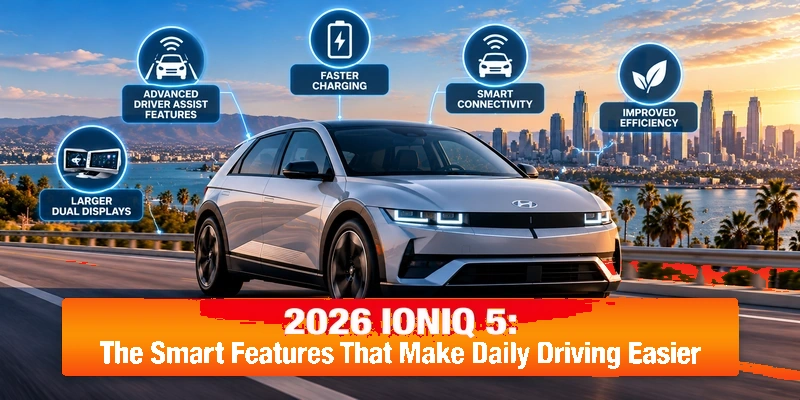
For many EV shoppers, range and charging speed are still the first things on the checklist. But once an electric vehicle becomes your daily commuter, the details you interact with every day can matter just as much. The 2026 Hyundai Ioniq 5 features are designed around those everyday situations.
The Ioniq 5 is not simply trying to make an electric SUV faster or more connected. Its smartest features focus on making everyday driving more convenient, from daily commutes and errands to long road trips and charging stops.
The best automotive technology is not always the feature you notice first.
It is the feature that quietly makes a routine drive easier.
Here are the 2026 Hyundai Ioniq 5 smart features that can make a meaningful difference in everyday U.S. driving.
1. Regenerative Braking Makes Stop-and-Go Driving Easier
Regenerative braking is one of the biggest differences between driving an EV and a conventional gasoline vehicle. Instead of wasting all of the vehicle’s kinetic energy as heat through the friction brakes, the Ioniq 5 can use the electric motor to slow the vehicle and recover energy.
The 2026 Ioniq 5 gives drivers multiple levels of regenerative braking that can be adjusted through steering-wheel paddles. At the strongest setting, i-Pedal allows the driver to accelerate and decelerate primarily with the accelerator pedal.
The important point is that i-Pedal is a driver-controlled regenerative braking function, not a substitute for the brake pedal or an autonomous traffic system. Drivers still need to monitor traffic and use the brake pedal whenever necessary.
For EV owners, however, learning to use regenerative braking effectively can make daily driving smoother while also helping recover energy.
2. The Flat Floor Creates More Useful Interior Space
The 2026 Ioniq 5 interior features are another reason this EV feels different from many conventional compact SUVs.
Because the vehicle is built on Hyundai’s dedicated E-GMP electric platform, the cabin has a flat floor rather than the transmission tunnel commonly found in gasoline-powered vehicles. The Ioniq 5 also has a 118.1-inch wheelbase, helping create generous passenger space for its exterior footprint.
The rear seats also have a 60/40 split-folding design with recline and slide functions, allowing owners to balance passenger comfort and cargo space depending on the trip.
3. A Sliding Center Console Adds Flexibility
One of the more distinctive Ioniq 5 convenience features is the available sliding center console.
On appropriately equipped models, the console can be repositioned to change how the front portion of the cabin is used. That flexibility can be useful when storing personal items, creating additional space between the front seats, or simply adjusting the cabin to suit different passengers.
The Ioniq 5’s interior philosophy is therefore less about filling every available surface with screens and more about making the space adaptable.
4. 12.3-Inch Displays and Wireless Smartphone Connectivity
The technology inside the Ioniq 5 is also designed around familiar digital habits. A 12.3-inch touchscreen is standard across the 2026 lineup, while wireless Apple CarPlay and Android Auto are also standard. Hyundai also includes onboard navigation, Bluetooth connectivity, and dynamic voice recognition.
For U.S. drivers, wireless smartphone integration can eliminate one of those small but repetitive annoyances: plugging in a phone simply to access navigation or media.
Higher trims add features such as wireless device charging, a head-up display, and Bose premium audio. The result is a cabin that feels more like a connected workspace without requiring drivers to learn an entirely unfamiliar interface.
5. Remote Smart Parking Assist 2 Takes the Stress Out of Tight Spaces
Parking is where the 2026 Hyundai Ioniq 5 technology becomes particularly practical. Remote Smart Parking Assist 2, or RSPA 2, is available on the XRT and Limited trims. The system can help park the vehicle remotely, including parallel parking and moving into or out of a parking space while the driver operates the system from outside the vehicle using the Smart Key.
However, RSPA 2 should not be treated as a system that can safely handle every parking situation without supervision. Hyundai notes that sensor condition and weather can affect performance, and drivers should inspect the area themselves before moving the vehicle.
That distinction is important: driver assistance reduces workload; it does not eliminate driver responsibility.
6. HDA 2 Makes Long Highway Drives Less Demanding
For drivers who regularly cover long stretches of interstate, one of the most useful Hyundai Ioniq 5 technology features is Highway Driving Assist 2. HDA 2 is standard on the SEL, XRT, and Limited trims. It combines lane-centering assistance with Smart Cruise Control and can assist with lane changes.
On a long trip across Texas, Arizona, California, or the Midwest, maintaining a consistent following distance and lane position can become tiring. HDA 2 is designed to reduce some of that repetitive workload.
The system can help maintain the selected speed and distance from the vehicle ahead while helping keep the Ioniq 5 centered in its lane. It can also assist with lane changes under appropriate conditions. But there is an important distinction between driver assistance and autonomous driving.
7. V2L Turns the Ioniq 5 Into a Mobile Power Source
Instead of using electricity only to move the vehicle, V2L allows the Ioniq 5 to supply power to external equipment. Hyundai lists applications such as camping equipment, electronics, power tools, televisions, and espresso machines.
A family heading to a campsite can use V2L for small electrical equipment. Someone working remotely can power certain devices away from a traditional outlet. A contractor can use the vehicle to provide electricity for compatible tools at a job site.
A family heading to a campsite can use V2L for small electrical equipment. Someone working remotely can power certain devices away from a traditional outlet. A contractor can use the vehicle to provide electricity for compatible tools at a job site.
8. Faster Charging Changes How You Plan Road Trips
Smart technology is not only about what happens inside the cabin. Charging convenience has a major effect on how an EV fits into American road-trip habits. The 2026 Ioniq 5 now uses a native NACS charging port, allowing access to the Tesla Supercharger network where compatible chargers are available.
Hyundai says 84-kWh battery models can charge from 10% to 80% in approximately 30 minutes on a NACS V3/V4 DC fast charger, although actual charging time depends on factors such as battery temperature, state of charge, charger output, and other conditions. The 2026 Ioniq 5’s charging hardware gives drivers more flexibility in both situations.
What Makes the 2026 Ioniq 5 Technology Different?
The most interesting aspect of the 2026 Hyundai Ioniq 5 features is not any single specification.
Regenerative braking can make traffic less tiring. The flat floor makes the cabin more usable. Wireless smartphone connectivity removes cable clutter. RSPA 2 can simplify difficult parking situations. HDA 2 can reduce the repetitive workload of highway driving. V2L adds functionality when the vehicle is parked. And NACS charging makes long-distance EV travel easier to plan.
The hybrid also uses deceleration selectors, allowing the driver to adjust regenerative deceleration. This can be particularly useful in traffic-heavy environments where drivers repeatedly accelerate and slow down.
Frequently Asked Questions
What are the best 2026 Hyundai Ioniq 5 features for daily driving?
The most useful 2026 Hyundai Ioniq 5 features include regenerative braking, wireless Apple CarPlay and Android Auto, a flexible interior, Smart Cruise Control, and available Remote Smart Parking Assist 2. HDA 2 is also available on SEL, XRT, and Limited trims.
Does the 2026 Ioniq 5 have V2L and fast charging?
Yes. The 2026 Ioniq 5 offers available Vehicle-to-Load capability, allowing the vehicle to power compatible devices and equipment. It also uses a native NACS port and supports DC fast charging, with Hyundai estimating about 30 minutes from 10% to 80% for 84-kWh models under specified charging conditions.
Which 2026 Ioniq 5 technology helps with highway driving?
Highway Driving Assist 2 is available on the SEL, XRT, and Limited. It can help maintain lane position, a set speed, and following distance while assisting with lane changes. It remains a driver-assistance system, so drivers must stay attentive and maintain control.
Final Takeaway
The 2026 Hyundai Ioniq 5 shows how EV technology can become genuinely useful when it solves everyday driving problems rather than simply adding more digital features. From tight parking garages to long interstate trips and weekend adventures, its technology is designed to make common tasks easier and more manageable.
If you have a car problem, need practical maintenance advice, or want to understand the latest vehicle technology before making your next move, check out the Mr.Leecar experts for useful car tips, U.S.-based car trends, automotive news, and the latest launches.


