

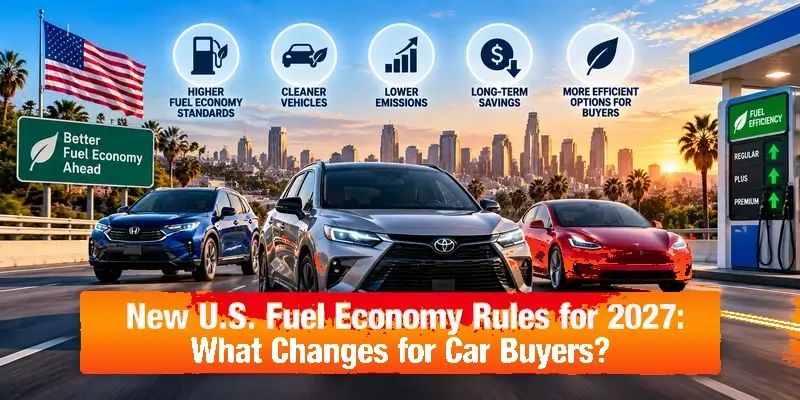
Buying a new vehicle in 2027 could mean shopping in a market shaped by a very different set of fuel economy rules than the ones automakers were preparing for just a few years ago. The latest federal changes affect how manufacturers calculate fleet fuel economy, classify certain vehicles, and decide which technologies make economic sense for future models.
That makes the new fuel economy rules for 2027 an important topic for anyone considering a new sedan, crossover, SUV, or pickup. Here is what the latest rules mean for vehicle choices, fuel economy, pricing, and long-term ownership.
What Are the 2027 U.S. Fuel Economy Rules?
The federal fuel economy program is known as Corporate Average Fuel Economy, or CAFE. It is administered by the National Highway Traffic Safety Administration and applies to manufacturers rather than individual drivers.
CAFE is designed around a manufacturer’s fleet. In other words, an automaker does not necessarily need every vehicle it sells to achieve the same fuel economy figure. The manufacturer’s overall fleet has to satisfy applicable requirements.
The latest NHTSA rule, published September 30, 2026, revises CAFE standards for model years 2022 through 2031, including the 2027–2031 period. The rule takes effect November 30, 2026. NHTSA estimates that the finalized requirements correspond to a combined industry fleet average of approximately 34.9 mpg in 2031 for passenger cars and light trucks.
This difference is one of the most important things to understand before interpreting headlines about the new car regulations for 2027.
Why the 2027 Rules Are Different From the Earlier Plan
The 2027 model year had previously been associated with a more aggressive CAFE trajectory finalized by NHTSA in 2024. That earlier rule projected an industry fleet average of roughly 50.4 mpg by 2031. The September 2026 SAFE Vehicles Rule III substantially recalibrates that approach. NHTSA now projects an average of about 34.9 mpg by 2031 instead of approximately 49.3 mpg under the previous 2024 standards.
The finalized 2026 rule also changes how certain vehicles are classified within the CAFE program. Those classification changes are scheduled to take effect in model year 2030, giving manufacturers additional time to adjust product planning.
Don't Expect Every 2027 Vehicle to Become a Hybrid
One of the biggest misconceptions surrounding fuel economy regulations is that a new federal standard automatically means every automaker must turn to hybrids.
Manufacturers can use different technologies to meet their fleet requirements. Depending on the product strategy, those can include improvements to conventional gasoline engines, transmission technology, aerodynamics, weight reduction, non-plug-in hybrid systems, and other fuel-saving technologies.
NHTSA specifically states that manufacturers remain free to select the fuel economy technologies they use to meet the standards. For shoppers, this means the 2027 market will not suddenly become a hybrid-only marketplace.
Vehicle Prices Could Be Affected, but Not in One Direction
Fuel economy technology costs money. However, the relationship between regulations and the price on a dealer’s window sticker is not as simple as adding the cost of one new component to every vehicle.
NHTSA’s 2026 analysis estimates that the finalized CAFE reset could reduce technology costs compared with the previous standards. Under the agency’s analysis, average per-vehicle costs for new vehicles could be approximately $1,289 lower in model year 2031 than under the previous no-action scenario, assuming manufacturers pass the modeled cost reductions through to consumers. For a buyer, the practical takeaway is to avoid assuming that a regulatory change automatically produces either a price increase or a price cut across the entire market.
SUVs and Crossovers Deserve Special Attention
If you are shopping for an SUV, crossover, or pickup, pay attention to how vehicle classification affects the manufacturer’s CAFE calculations. The CAFE system uses vehicle characteristics, including footprint-based calculations, to determine applicable targets. The latest rule also changes the criteria used to classify certain vehicles as passenger automobiles or non-passenger automobiles. The finalized classification changes begin in model year 2030.
For shoppers, this could become particularly relevant as automakers redesign or reposition crossover models during the next several product cycles. A compact crossover that looks like a familiar five-seat family vehicle may not necessarily be treated identically to a sedan for regulatory purposes.
Large Engines Are Not Automatically Disappearing in 2027
Another common assumption is that the new fuel economy rules in 2027 will immediately eliminate V6 or V8 engines. The rules do not contain a simple ban on large-displacement engines. Instead, manufacturers evaluate the cost and feasibility of different technologies across their entire vehicle portfolios.
A manufacturer may improve an existing gasoline engine, add cylinder deactivation, revise gearing, introduce a hybrid system, reduce vehicle weight, improve aerodynamics, or use another combination of technologies. This is especially relevant for American buyers who depend on pickups and SUVs for towing, commuting, family transportation, or work. The latest CAFE rule is explicitly designed around manufacturer fleet requirements rather than a one-powertrain-fits-all approach.
What 2027 Car Buyers Should Check Before Buying
The smartest way to respond to changing fuel economy changes for car buyers is to focus on the actual vehicle rather than the headline surrounding the regulation.
Check the EPA window sticker
Look at the vehicle’s combined MPG, estimated annual fuel cost, and fuel-economy information before comparing models.
Calculate your annual fuel use
Take your expected annual mileage and divide it by the vehicle’s combined MPG. Multiply the result by the gasoline price you realistically expect to pay. This gives you a more useful ownership estimate than simply comparing MPG numbers.
Compare similar powertrains
A conventional gasoline crossover, hybrid crossover, and plug-in hybrid can have very different operating costs and driving characteristics. Compare the technology with how you actually use your vehicle.
Consider your driving environment
A commuter traveling long distances on highways may evaluate fuel economy differently from someone who drives mostly short trips in cities.
For example, a driver commuting between suburbs and a major employment center may accumulate significantly more annual mileage than someone who uses a vehicle primarily for weekend errands.
Look at the complete ownership picture
Fuel is only one part of ownership. Insurance, maintenance, financing, depreciation, tires, registration, and repair costs can all affect what a vehicle ultimately costs.
What These Rules Mean for the Used-Car Market
There is another angle that new-car shoppers often overlook. Changes in new-vehicle regulations do not immediately transform the used-car market.
If manufacturers alter powertrains or vehicle configurations in response to changing regulatory requirements, those vehicles will take years to work their way into the used-car fleet. That means someone shopping for a used 2027 model several years from now should evaluate the specific vehicle’s maintenance history, fuel economy, warranty status, mileage, and powertrain condition rather than assuming that its model year alone tells the whole story.
For buyers keeping a vehicle for seven to ten years, this longer-term perspective can be especially useful.
Final Thoughts
The 2027 U.S. fuel economy rules are less about forcing one type of vehicle onto American roads and more about changing the regulatory framework manufacturers use when planning their fleets. The latest NHTSA rule resets the CAFE trajectory for 2027–2031, with the agency projecting a combined fleetwide average of about 34.9 mpg by 2031. It also changes vehicle-classification rules beginning in 2030.
For consumers, the biggest lesson is to avoid making a purchase decision based on the regulation alone. Instead, compare the actual vehicle’s MPG, purchase price, fuel requirements, maintenance needs, warranty coverage, expected annual mileage, and long-term ownership costs. And remember: a fleetwide CAFE target is not the same thing as the MPG rating of the car sitting in front of you at the dealership.
Frequently Asked Questions
Will the 2027 U.S. fuel economy rules require me to buy an EV?
No. The 2027 U.S. fuel economy rules regulate manufacturer fleet performance rather than requiring individual consumers to purchase electric vehicles. Automakers can use different technologies to meet their applicable CAFE requirements.
Will the new fuel economy rules 2027 make cars more expensive?
Not necessarily. The latest NHTSA analysis projects lower technology costs compared with the previous regulatory scenario, but actual vehicle prices will continue to depend on manufacturing costs, equipment, market demand, financing, tariffs, and other factors.
How can I reduce my fuel costs when buying a 2027 vehicle?
Compare the EPA combined MPG ratings, estimate your annual mileage, and calculate expected fuel consumption before choosing a vehicle. A slightly higher purchase price can sometimes make sense when the vehicle uses substantially less fuel, but the calculation should be based on your actual driving habits and expected fuel prices.
If you have a car problem or need smarter advice before your next vehicle purchase, check with Lee Car experts for practical car tips, troubleshooting guidance, and useful ownership insights.

