

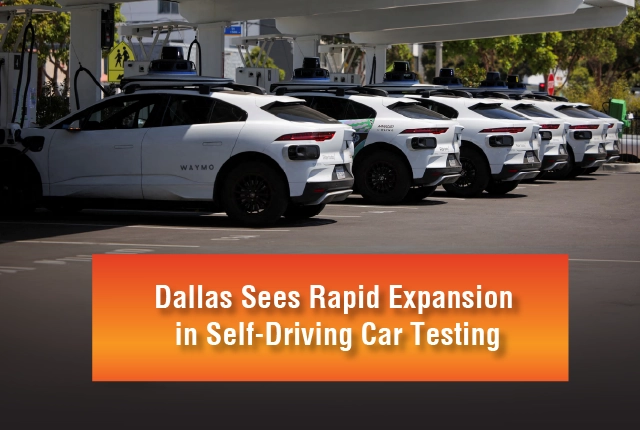
If you have recently driven through Downtown Dallas, merged onto Central Expressway, or spent time navigating the fast-moving streets of Deep Ellum, you may have noticed something unusual sitting beside you in traffic. Not a distracted commuter. Not a rideshare driver checking GPS directions.
Instead, you may have spotted a vehicle covered in spinning rooftop sensors, advanced cameras, radar systems, and artificial intelligence technology quietly making decisions in real time and sometimes without anyone touching the steering wheel.
What once sounded like science fiction is now becoming part of everyday life across North Texas. Dallas has rapidly emerged as one of the largest autonomous vehicle testing hubs in the United States. From robotaxi services to AI-powered delivery fleets, the city is becoming a critical proving ground for the future of transportation.
The self-driving car expansion Texas is witnessing goes far beyond flashy technology. It is reshaping road safety, traffic systems, insurance models, urban planning, and the future of the daily commute.
Why Autonomous Vehicle Companies Are Flocking to Dallas?
While Silicon Valley develops much of the software powering self-driving systems, Texas has become the place where companies test whether that technology can survive real-world traffic. Dallas, in particular, offers the ideal combination of infrastructure, weather conditions, urban complexity, and business-friendly regulations. Here is why autonomous vehicle companies are aggressively expanding across North Texas.
Texas Has Autonomous Vehicle-Friendly Laws
One of the biggest reasons companies are prioritizing autonomous vehicle testing in Dallas is the state’s regulatory environment.
Texas allows autonomous vehicles to operate under relatively flexible statewide regulations as long as they comply with federal motor vehicle safety standards.
Compared to states with stricter testing restrictions, Texas provides fewer regulatory barriers, faster commercial deployment opportunities, expansive public road networks, and strong business investment incentives for autonomous vehicle companies. This has helped Texas become one of the most attractive states for autonomous driving companies looking to scale quickly.
| Key Factor | Why It Matters for Self-Driving Cars | Dallas Advantage |
|---|---|---|
| State Regulations | Easier testing and commercial deployment | Texas has autonomous vehicle-friendly laws |
| Road Infrastructure | Helps AI systems learn complex traffic behavior | Large freeway systems and dense urban traffic |
| Weather Conditions | Tests vehicle performance in unpredictable environments | Flash floods, storms, and extreme heat |
| Traffic Complexity | Improves machine learning decision-making | Congested highways and busy intersections |
| Urban Expansion | Creates diverse real-world driving scenarios | Rapid suburban and metro growth |
| Technology Investment | Accelerates autonomous vehicle innovation | Growing presence of major AI and mobility companies |
Dallas Offers Real-World Driving Complexity
Autonomous driving systems cannot improve in controlled environments alone. Artificial intelligence learns best when exposed to unpredictable real-world traffic situations.
Dallas provides exactly that. The city challenges AI systems with multi-lane freeway congestion, aggressive lane changes, complex highway interchanges, construction-heavy corridors, and dense downtown traffic patterns.
From Interstate 635 to Downtown Dallas intersections, autonomous vehicles must constantly process massive amounts of real-time information. That complexity is exactly what makes Dallas valuable to self-driving technology companies.
Major Tech Companies Are Expanding in Dallas
Several leading autonomous vehicle companies are investing heavily across Texas. Major players currently involved in autonomous vehicle expansion include Waymo, Tesla, Aurora Innovation, Cruise, Zoox, and Motional. The Dallas-Fort Worth metroplex has effectively become one of the most important battlegrounds in America’s autonomous driving race.
The Rise of Robotaxis in Dallas
One of the biggest changes Dallas residents are beginning to notice is the rapid rise of robotaxis. These fully autonomous vehicles function similarly to traditional rideshare services, except there is no human driver behind the wheel.
Passengers simply:
- Open an app
- Request a ride
- Enter the vehicle
- Reach their destination autonomously
For many people, the experience still feels futuristic. However, technology companies believe robotaxis could eventually transform urban transportation entirely. The long-term vision includes reducing personal car ownership, lowering transportation costs, minimizing traffic congestion, and reducing parking demand in major city centers. Autonomous ride-hailing services could fundamentally reshape how Americans commute within large metropolitan areas.
How Self-Driving Cars Could Improve Road Safety
One of the strongest arguments in favor of autonomous vehicles is the potential to reduce traffic accidents caused by human error. Human drivers frequently make dangerous mistakes because of distracted driving, fatigue, speeding, road rage, impaired driving, and delayed reaction times. While the technology is still evolving, many transportation experts believe autonomous systems could significantly reduce traffic fatalities in the coming decades.
Self-driving vehicles rely on radar systems, LiDAR sensors, AI-powered cameras, predictive software, and machine learning algorithms to navigate safely. These systems continuously scan the environment in every direction and react much faster than human reflexes in many situations. Autonomous vehicles also strictly follow traffic laws, maintain safe following distances, and avoid emotional decision-making.
Severe Texas Weather Creates Problems for AI Systems
Texas weather is notoriously unpredictable. Autonomous vehicles must operate safely during heavy rainstorms, flash flooding, low visibility conditions, hailstorms, and sudden road hazards.
Flooded roadways are particularly dangerous because cameras and sensors can struggle to estimate water depth accurately. Following weather-related incidents involving autonomous vehicles in Texas, companies began improving software systems designed to detect standing water more effectively. Weather adaptation remains one of the industry’s largest technical challenges.
Construction Zones Continue to Confuse Self-Driving Cars
Dallas road construction is constant. Temporary detours, lane closures, missing lane markings, cones, and inconsistent signage can create confusion for autonomous systems. Human drivers often improvise instinctively in construction zones. AI systems require large amounts of training data before they can respond safely in unusual scenarios. This is why companies rely heavily on Dallas for testing. Every unexpected road condition helps train autonomous driving software to improve future performance.
Public Trust Remains a Major Obstacle
Even if the technology improves rapidly, public trust remains one of the biggest hurdles facing the autonomous vehicle industry. Many Americans still feel uncomfortable riding inside a vehicle without a driver.
Common public concerns include software malfunctions, cybersecurity risks, system reliability, emergency response handling, and accident liability questions. For autonomous vehicle companies, success depends on more than just engineering. They must also convince the public that self-driving technology is safe, reliable, and trustworthy
How Autonomous Vehicles Could Transform Dallas Traffic
If autonomous transportation expands successfully, Dallas could experience major infrastructure changes over the next decade. Transportation analysts predict several long-term benefits.
Reduced Traffic Congestion
Self-driving vehicles can communicate with each other more efficiently than human drivers. This could eventually improve traffic flow and reduce stop-and-go congestion.
Smarter Traffic Systems
Future smart-city infrastructure may allow autonomous vehicles to interact directly with traffic lights, road sensors, navigation systems, emergency services, and public transportation networks. This connected transportation ecosystem could dramatically improve urban mobility.
Lower Transportation Costs
Autonomous ride-sharing systems may eventually become more affordable than personal vehicle ownership in some cities. Consumers could potentially save money on insurance, fuel, vehicle maintenance, parking expenses, and long-term car ownership costs. This could change how Americans think about long-term transportation.
Reduced Parking Demand
Robotaxis may significantly reduce the need for massive parking lots in urban areas. Instead of sitting parked for hours, autonomous vehicles could continuously transport passengers throughout the day. That shift could eventually reshape city planning and commercial development.
What Dallas Drivers Should Expect Next
Autonomous vehicle testing in Dallas is still in its early stages. Over the next several years, residents will likely see more robotaxis operating publicly, expanded testing zones, AI-powered delivery vehicles, smarter traffic systems, and increased highway automation trials.
At first, these changes may feel unusual. However, transportation technology tends to evolve quickly once public adoption begins. Just as rideshare apps transformed commuting habits within a decade, autonomous vehicles could fundamentally reshape transportation across the United States. Dallas simply happens to be one of the first cities experiencing this transition in real time.
Final Thoughts: The Future of Self-Driving Cars in America
The autonomous driving race is no longer experimental. It is commercial. Billions of dollars are being invested in AI-powered transportation because companies believe autonomous mobility could become one of the largest transformations in automotive history. The impact could extend far beyond convenience.
Self-driving technology may eventually reshape insurance industries, commercial trucking, public transportation, urban planning, vehicle manufacturing, and traffic safety regulations. Texas has positioned itself at the center of this technological shift. And Dallas has become one of America’s most important autonomous vehicle testing hubs. Whether consumers fully embrace the technology or remain cautious, one thing is clear: The future of transportation is already driving through Dallas streets today.
Frequently Asked Questions
Is self-driving car testing in Dallas legal?
Yes. Texas allows autonomous vehicle operations as long as companies comply with federal safety standards and transportation regulations. Dallas has become one of the largest autonomous vehicle testing regions in the United States.
Are robotaxis currently operating in Dallas?
Yes. Several autonomous vehicle companies are expanding commercial robotaxi services across Texas. Availability depends on active service zones, local rollout phases, and provider coverage areas.
How do autonomous vehicles handle severe Texas weather?
Most autonomous vehicle companies temporarily pause operations during dangerous weather conditions such as flash flooding, severe thunderstorms, or hailstorms. Engineers continuously update AI systems to improve safety performance during extreme weather events.
For the latest U.S. car trends, autonomous driving updates, vehicle maintenance hacks, safe driving tips, automotive launches, and breaking car news, have a look at Mr.Leecar Experts.