

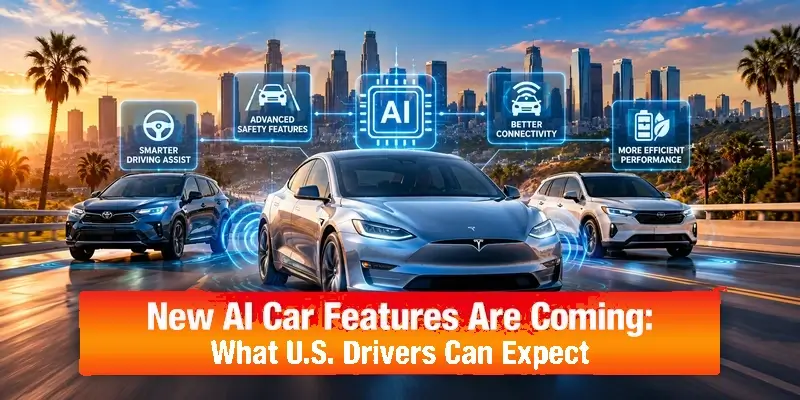
Your next car may do far more than help you get from one destination to another. It may understand a spoken request, recognize changing traffic conditions, predict when a component needs attention, personalize the cabin, and continuously improve through software updates.
That shift is already happening across the U.S. automotive market. AI car features are moving beyond futuristic concepts and becoming part of the technology buyers encounter in new vehicles.
For a driver commuting through Los Angeles traffic, crossing Texas on I-35, dealing with winter roads in Michigan, or making a long EV trip through the Southwest, the value of artificial intelligence is becoming less about flashy technology and more about reducing everyday driving friction.
The next generation of cars will not simply respond to drivers.
They will increasingly understand their surroundings.
Here is what U.S. drivers should know about the latest AI features in cars, where the technology is heading, and what may become standard in vehicles over the next few years.
Why AI Is Becoming a Bigger Part of the Modern Car
Cars have been collecting electronic data for years. The major change now is what manufacturers can do with that information.
Modern vehicles can process information from cameras, radar, microphones, GPS, vehicle sensors, driver-monitoring systems, battery-management systems, and other electronic control units. Machine-learning and AI software can then interpret that information and use it to support decisions or automate specific functions.
Instead of every capability being fixed when a vehicle leaves the factory, software can increasingly be updated, refined, and expanded after purchase.
1. AI Voice Assistants Will Become More Conversational
One of the most visible AI car features will be the way drivers communicate with their vehicles. Traditional automotive voice systems generally depend on specific commands. AI-powered assistants can interpret more natural language and maintain context across multiple requests.
BMW is already moving in this direction. Its next-generation Intelligent Personal Assistant uses Amazon Alexa+ technology and large language model capabilities to enable more natural conversations, including requests involving vehicle functions and external information. BMW says the technology is being introduced in the U.S. during 2026.
2. AI-Powered ADAS Will Understand More Than Objects
Today’s systems can already identify vehicles, pedestrians, lane markings, cyclists, and other road users. The next step is improving how the vehicle interprets what those objects are doing. For instance, detecting a pedestrian is one task. Understanding that the pedestrian has moved toward the edge of a crosswalk is more useful.
The same principle applies to cyclists, merging vehicles, stopped traffic, road debris, and rapidly changing traffic patterns. AI-based perception systems combine information from multiple sensors and use computer-vision algorithms to build a more detailed picture of the road.
A driver on a busy Los Angeles freeway may encounter dense traffic and lane changes. A driver on an interstate in Colorado may deal with snow, reduced visibility, and inconsistent lane markings. In Florida, heavy rain can change visibility and road conditions within minutes. AI cannot eliminate these hazards, but better perception can help assistance systems respond more appropriately.
What U.S. Drivers Need to Know About Level 2
This is also where consumers need to understand the difference between AI-powered assistance and self-driving technology. NHTSA classifies systems that can simultaneously assist with steering and acceleration/braking as Level 2, while the driver remains responsible and must continuously monitor the driving environment.
GM reported in 2026 that customers had accumulated more than 1 billion hands-free miles using Super Cruise, while Ford describes BlueCruise as a Level 2 system that still requires the driver’s full attention.
3. Predictive Maintenance Could Change How Drivers Service Their Cars
Another important category of AI car technology is predictive maintenance. Most drivers are familiar with maintenance reminders based on mileage or time. AI can potentially make those recommendations more condition-based.
A vehicle can continuously monitor information such as:
- Battery performance
- Engine operating data
- Brake system behavior
- Tire-pressure changes
- Temperature patterns
- Charging behavior
- Electrical-system performance
- Sensor faults
AI models can analyze those patterns and identify unusual behavior before it develops into a more obvious problem. For an EV owner, this could mean detecting changes in battery performance or thermal behavior earlier. For a gasoline vehicle, similar systems could help identify patterns associated with component wear or mechanical faults.
The benefit is not that AI can predict every breakdown perfectly. It is that maintenance can become more proactive and data-driven rather than relying only on fixed service intervals.
For U.S. drivers who regularly travel long distances, that distinction can be valuable. A warning about a developing problem before a 500-mile road trip is far more useful than discovering the issue halfway across an interstate.
4. Driver Monitoring Will Become More Intelligent
AI is also being used inside the cabin to understand the driver’s condition. Interior cameras and machine-vision systems can monitor factors such as eye position, head movement, gaze direction, and signs of distraction or fatigue. This is particularly relevant to the U.S. because long-distance driving is common. A driver may spend hours on Interstate 80, I-10, I-95, or another major corridor where fatigue can gradually become a serious safety concern.
A driver-monitoring system can detect when attention appears to be moving away from the road and issue an alert. The technology is not intended to replace responsible driving. Instead, it adds another layer of monitoring when human attention begins to decline. NHTSA emphasizes that current driver-assistance systems remain assistive technologies and that drivers must understand how their vehicle’s systems work and remain responsible for operating the vehicle.
5. Connected Cars Will Use AI to Respond to Traffic and Road Conditions
The future of AI cars in the USA will also depend on how well vehicles communicate with the wider transportation network. Navigation systems already use live traffic information. AI can take that data further by analyzing traffic flow, road incidents, weather conditions, construction zones, and historical patterns to recommend better routes.
Vehicle-to-infrastructure technology could eventually allow vehicles to interact more closely with traffic signals and other connected road infrastructure. For U.S. cities dealing with congestion, this could become particularly valuable. The technology is still developing, but the broader direction is clear: the intelligent vehicle is becoming part of a larger connected transportation system rather than an isolated machine.
Final Takeaway
The biggest change coming to American vehicles may not be a car that suddenly drives itself everywhere.
Voice assistants will become more conversational. ADAS will become more context-aware. EVs will become better at predicting energy needs. Maintenance alerts will become more predictive. Vehicle software will become increasingly personalized. And as automakers collect more real-world driving data, the relationship between hardware, software, cloud services, and the vehicle itself will become even more important.
Frequently Asked Questions About AI Car Features
What are the most common AI features in cars?
Common AI features in cars include advanced driver assistance, natural-language voice assistants, driver monitoring, intelligent navigation, predictive diagnostics, automated parking, and adaptive vehicle systems. Availability varies by manufacturer, model, trim, and market.
How does artificial intelligence in cars improve safety?
Artificial intelligence in cars can process information from cameras, radar, and other sensors to identify potential hazards, support automatic emergency braking, assist with lane positioning, monitor driver attention, and improve the vehicle’s understanding of surrounding traffic. However, current consumer driver-assistance systems still require appropriate driver supervision.
Are AI cars in the USA fully self-driving?
Most consumer AI cars in the USA are not fully self-driving. Many use Level 1 or Level 2 driver-assistance technologies, where the driver remains responsible for monitoring the vehicle and roadway. Fully autonomous services exist in specific commercial operating areas, but they are different from buying a consumer vehicle with conventional ADAS.
If you have a car problem or want practical car hacks, maintenance tips, new-car technology updates, U.S. car trends, news, and upcoming launches, check out Mr. Leecar Experts.

