Texas has become one of the most important manufacturing destinations in the United States, attracting billions of dollars in investments across industries ranging from semiconductors and energy to aerospace and automotive production. As companies continue to look for strategic locations that offer skilled labor, transportation access, and long-term growth opportunities, Central Texas has emerged as a clear winner.
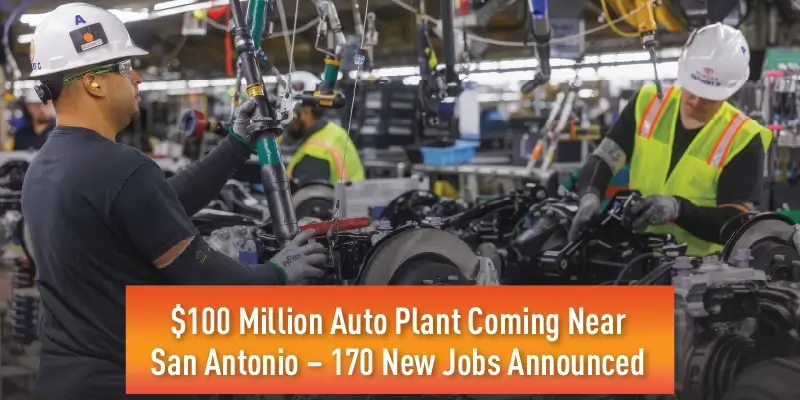
The latest example comes from Seguin, a rapidly growing city east of San Antonio that is set to welcome a major automotive manufacturing facility. Global automotive supplier H-One Co., Ltd., through its North American subsidiary KTH Texas, Inc., has announced plans to build a new $100 million manufacturing plant that will strengthen the region’s position in the North American automotive supply chain.
The project represents far more than a new industrial building. It reflects the continued transformation of the San Antonio-Austin corridor into a hub for advanced manufacturing and automotive innovation. It also highlights how Texas is benefiting from growing demand for domestically produced automotive components as manufacturers seek stronger, more resilient supply chains.
For residents, job seekers, and industry observers, this investment offers a glimpse into the future of automotive manufacturing in Texas and the broader economic opportunities that come with it.
A Major Manufacturing Investment Arrives in Seguin
KTH Texas plans to develop a 300,000-square-foot advanced manufacturing facility on a 40-acre site in Seguin, strategically located near Interstate 10, Highway 46, and FM 78. The location provides direct access to key transportation routes connecting San Antonio, Austin, Houston, and other major industrial centers across the state.
Construction is expected to begin before the end of 2026, with production operations targeted to start in April 2028. Once fully operational, the facility is expected to create approximately 170 new jobs by 2031.
The investment includes not only the construction of the facility itself but also the installation of advanced manufacturing equipment, automated production systems, and specialized machinery designed to produce high-performance automotive components.
At a time when many manufacturers are reshaping supply chains and investing closer to their customer base, the Seguin project demonstrates growing confidence in Texas as a long-term center for automotive production.
| Project Overview | Details |
|---|---|
| Company | KTH Texas, Inc. |
| Location | Seguin, Texas |
| Investment | $100 Million+ |
| Facility Size | 300,000 Square Feet |
| Site Area | 40 Acres |
| New Jobs | 170 Positions |
| Construction Start | Late 2026 |
| Operations Begin | April 2028 |
| Primary Focus | Automotive Structural Components |
Advanced Automotive Components Will Drive the Facility’s Production
Unlike traditional vehicle assembly plants that produce finished cars and trucks, the new Seguin facility will focus on manufacturing structural components that form the foundation of modern vehicles.
The plant will specialize in producing ultra-high-strength steel and structural aluminum components used in vehicle frames, chassis systems, and safety structures. These components are essential to modern automotive engineering, particularly as manufacturers work to improve safety, reduce vehicle weight, and increase efficiency.
While these parts may never be visible to consumers, they play a critical role in how vehicles perform. Modern vehicle platforms depend on advanced materials that can deliver strength without adding unnecessary weight. This balance has become increasingly important as automakers develop new generations of electric vehicles, hybrids, and fuel-efficient gasoline-powered models.
The investment in advanced manufacturing technology also reflects a broader shift within the automotive industry. Manufacturers are increasingly relying on automation, robotics, and precision engineering to improve quality while maintaining production efficiency. Facilities like the one planned in Seguin are designed to meet those evolving demands.
Strengthening the San Antonio-Austin Automotive Corridor
The announcement further solidifies the growing reputation of the San Antonio-Austin corridor as one of the most important manufacturing regions in Texas.
Over the past two decades, the region has attracted significant industrial investment thanks to its strategic location, expanding workforce, and transportation infrastructure. Automotive manufacturing has played a particularly important role in that growth.
The presence of major vehicle production operations in South Texas has encouraged the development of an extensive supplier network throughout the surrounding region. As vehicle manufacturers seek to shorten supply chains and improve logistics efficiency, suppliers increasingly look for locations that provide quick access to assembly plants and distribution networks.
Industry analysts have noted that supplier investments often serve as a strong indicator of future manufacturing confidence. When component manufacturers commit substantial resources to new facilities, it typically reflects long-term expectations for production demand and market growth.
Economic Impact Extends Beyond the Factory Gates
Large manufacturing projects often generate significant secondary benefits throughout local economies. Construction activities alone create opportunities for contractors, engineers, equipment suppliers, and service providers during the development phase. Once operations begin, additional economic activity typically follows.
New employees contribute to the local economy through housing, retail spending, healthcare services, dining, and transportation. As a result, businesses throughout Seguin and the surrounding region may experience increased demand as the workforce expands.
The project is also expected to support local tax revenues, which can contribute to infrastructure improvements, public services, and future economic development initiatives. Communities that successfully attract advanced manufacturing investments often experience long-term economic benefits that extend well beyond the initial project announcement.
In addition, manufacturing facilities require ongoing support from logistics companies, maintenance providers, industrial suppliers, and professional service firms. This creates opportunities for local businesses to participate in the broader economic ecosystem generated by the plant. For a growing community like Seguin, the project represents both immediate investment and long-term economic momentum.
New Career Opportunities in Advanced Manufacturing
Modern automotive manufacturing facilities operate very differently from traditional factories of previous generations. Advanced automation, robotics, digital monitoring systems, and precision engineering now play central roles in daily operations.
The Seguin facility is expected to generate demand for professionals involved in automation, robotics maintenance, industrial engineering, quality control, manufacturing operations, and supply chain management. Skilled trades such as tool and die repair, industrial maintenance, and equipment servicing are also expected to play important roles.
Educational institutions and workforce development organizations across Texas have increasingly aligned training programs with the needs of advanced manufacturing employers. This trend is likely to continue as projects like the KTH Texas facility move toward operational readiness.
For individuals considering long-term career opportunities, advanced manufacturing remains one of the most stable and technologically sophisticated sectors within the modern economy. The combination of competitive wages, technical development, and career advancement opportunities continues to attract a new generation of workers to the industry.
Key Benefits of the New KTH Texas Facility
- More than $100 million in capital investment for Central Texas
- Creation of 170 high-skilled manufacturing jobs by 2031
- Expansion of domestic automotive component production
- Increased demand for engineering, automation, and technical talent
- Stronger regional and national automotive supply chains
- Support for next-generation vehicle manufacturing technologies
- Additional economic growth opportunities for Seguin and Guadalupe County
Why Texas Remains a Magnet for Automotive Investment?
Texas offers several advantages that consistently attract major industrial investments. Its central geographic location provides efficient access to domestic markets, while extensive highway, rail, and port infrastructure supports large-scale logistics operations.
The state’s growing population has also helped create a robust labor force capable of supporting expanding industries. Combined with a business-friendly environment and significant industrial development capacity, these factors have positioned Texas as a preferred destination for manufacturers.
The automotive industry, in particular, has become increasingly important to the state’s economic future. As vehicle technologies continue to evolve, suppliers are investing in facilities that can support new production methods, advanced materials, and changing consumer demands.
The rise of electric vehicles, lightweight vehicle architecture, and increasingly sophisticated safety systems is driving demand for specialized manufacturing capabilities. Facilities like the one planned in Seguin are designed to meet those requirements while helping maintain domestic production capacity.
Final Thoughts: The Bigger Picture for Central Texas Manufacturing
The announcement of a $100 million automotive manufacturing facility in Seguin reflects more than a single corporate investment. It highlights the growing role that Central Texas is playing in the future of American manufacturing.
As vehicle production becomes increasingly dependent on advanced materials, automation, and precision engineering, suppliers capable of supporting those technologies will become even more important. The new KTH Texas facility positions the region to participate directly in that evolution. With construction expected to begin in 2026 and operations scheduled for 2028, the project will be closely watched as it moves from planning to production. If current industry trends continue, it may also catalyze additional automotive investments throughout Central Texas in the years ahead.
Frequently Asked Questions
When will the new Texas auto plant near San Antonio begin operations?
The new KTH Texas manufacturing facility in Seguin is expected to begin production operations in April 2028, following construction that is scheduled to start before the end of 2026.
How many jobs will the Seguin automotive manufacturing facility create?
The project is expected to create approximately 170 new jobs by 2031, including positions in advanced manufacturing, automation, engineering, quality control, and industrial maintenance.
What automotive components will be produced at the new Texas facility?
The plant will manufacture ultra-high-strength steel and structural aluminum components used in vehicle frames, chassis systems, and safety structures for modern passenger vehicles and future mobility platforms.
For more maintenance hacks, vehicle ownership tips, automotive industry updates, and the latest US car news and vehicle launches, just have a look at Mr. Leecar Experts.