

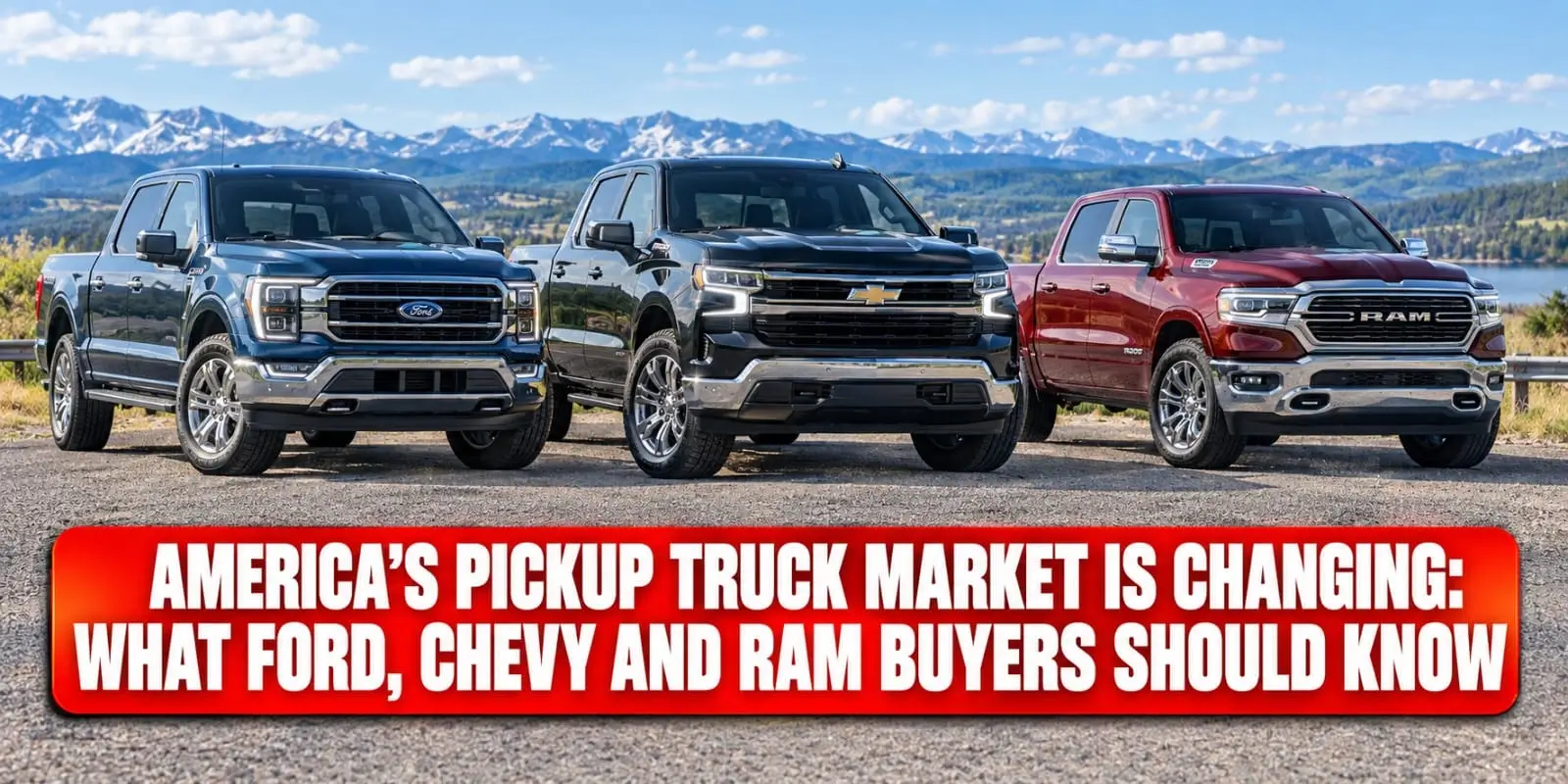
The American pickup truck is no longer just a choice between a V8, a diesel, and the biggest towing number on the window sticker.
In 2026, truck buyers are walking into a very different market. Ford pickup trucks, Chevy pickup trucks, and Ram pickup trucks are competing across more powertrain types, technology packages, price points, and use cases than ever before. Gas engines remain important, hybrids are becoming more practical, electric trucks are finding their place, and advanced towing and driver-assistance technology are becoming part of the mainstream truck-shopping conversation.
At the same time, the cost of buying a full-size pickup has become a major consideration. Kelley Blue Book data from Cox Automotive put the average transaction price for a new full-size pickup at $67,446 in August 2026, up 2.1% from a year earlier. The average transaction price across all new vehicles was $50,089.
Here is how the American pickup truck market is evolving and what those changes mean for buyers.
1. Full-Size Trucks Are More Expensive, but Affordable Work Trucks Still Exist
One of the biggest misconceptions in today’s pickup truck market trends is that every full-size truck has become a $60,000-plus vehicle.
Manufacturers still build basic work-oriented versions of their full-size pickups, but many buyers move quickly from the advertised entry price into higher trims once they add four-wheel drive, crew-cab configurations, larger engines, towing equipment, upgraded infotainment, and safety technology.
The 2026 Chevrolet Silverado 1500 is a useful illustration. Its Work Truck trim starts at $36,900, while the lineup extends through considerably more expensive configurations. The Silverado also offers an available 5.3-liter V8 and up to 13,300 pounds of available trailering capability, depending on configuration.
Conversely, someone using a truck as a daily driver and family vehicle may find that a mid-level crew cab delivers better long-term value than a stripped-down model with expensive options added individually. This is also where midsize pickups such as the Ford Ranger and Chevrolet Colorado deserve attention. They can provide useful towing and payload capability while generally requiring less money and physical space than a full-size truck.
2. Ford Is Making Powertrain Choice Part of the F-150 Strategy
Among Ford pickup trucks, the F-150 remains at the center of Ford’s strategy, but the traditional formula has expanded.
Ford’s Pro Power Onboard system can turn the truck into a mobile source of electrical power. Depending on configuration, the system can provide multiple levels of electrical output, making it useful for contractors, outdoor recreation, emergency backup applications, and work at locations without convenient electrical access.
For a buyer who spends most weekdays commuting but occasionally uses the truck for a job site, this kind of feature can be more meaningful than an extra few hundred pounds of maximum towing capacity.
Ford is also continuing to integrate connectivity and digital features throughout the F-150 range. That means buyers should evaluate not only horsepower and payload but also how they expect to use the truck’s technology over a five- or seven-year ownership period.
3. Chevy Is Keeping the V8 While Expanding Into Electric Trucks
The Chevy pickup truck lineup demonstrates that electrification does not necessarily mean abandoning conventional engines. The Silverado 1500 continues to offer gas-powered configurations, including an available 5.3-liter V8, while Chevrolet also sells the all-electric Silverado EV.
The 2026 Silverado EV illustrates how far the electric pickup segment has developed. Chevrolet lists up to 478 miles of GM-estimated range, up to 12,500 pounds of available towing, and a starting price of $55,895 for the Custom configuration on its current model page.
Towing, payload, weather, driving speed, temperature, and charging availability can all affect real-world range. A buyer who regularly pulls a heavy trailer through rural areas should evaluate charging infrastructure and expected range under load rather than assuming the advertised maximum will apply to every trip.
4. Ram Proved That the V8 Debate Is Far From Over
Ram’s 2026 strategy may be the clearest evidence that American truck buyers still have strong preferences about powertrains.
For 2026, the standard-output Hurricane produces 420 horsepower and 469 lb-ft of torque, while the HEMI produces 395 horsepower and 410 lb-ft of torque. The HEMI is therefore not simply the automatic performance choice; buyers have to consider how they value engine character, output, efficiency, towing requirements, and price.
If you tow frequently, compare the actual tow rating of the exact configuration. If you spend most of your time commuting, examine fuel economy and operating costs. And if the sound and character of a V8 are part of why you want a truck, the 2026 Ram 1500 gives buyers another opportunity to choose one.
5. The Real Truck Deal Depends on Where You Shop
Truck pricing can vary substantially between dealerships because inventory, local demand, manufacturer incentives, trade-in activity, and the popularity of particular configurations differ from one market to another.
A diesel-heavy market with strong demand for heavy-duty pickups may behave differently from a large metropolitan area where half-ton crew-cab trucks are primarily purchased as daily transportation.
This makes local inventory research one of the most useful steps a buyer can take.
Instead of searching only for a specific model within 20 miles, compare dealers across a wider radius. Look at the exact trim, drivetrain, cab configuration, bed length, packages, and installed options. Two trucks that appear identical online can have significant differences in equipment.
For shoppers, that creates a reason to compare remaining 2026 inventory rather than automatically waiting for a 2027 badge.
6. Financing Can Matter More Than a Small Discount
A $2,000 discount can sound attractive, but the financing structure can have a much larger effect on what a truck ultimately costs. Cox Automotive reported that the estimated average new-vehicle loan rate was 9.49% in August 2026, while the average new-vehicle transaction price was approximately $50,090.
Truck buyers should therefore compare the complete deal:
- Selling price
- Manufacturer incentives
- Dealer discounts
- Financing APR
- Loan term
- Down payment
- Trade-in value
- Taxes and fees
- Optional protection products
- Cost of accessories installed by the dealer
A truck with a slightly higher sticker price can sometimes produce a different monthly payment depending on financing incentives, while a lower advertised price may not tell the whole story.
7. The Biggest 2026 Pickup Truck Trend: More Choices, Not One Replacement Technology
The most important development in the American pickup truck market may not be the rise of EVs, the return of the HEMI, or the expansion of hybrid technology by itself.
Ford offers a full hybrid F-150 alongside gas-powered engines. Chevrolet maintains conventional Silverado powertrains while expanding the Silverado EV. Ram offers both Hurricane inline-six engines and the returning HEMI V8. That means the old argument that one technology will simply replace everything else does not fully describe today’s truck market.
For some drivers, gasoline remains the most convenient solution. For others, a hybrid can make sense because it combines familiar refueling with additional efficiency and electrical capability.
How to Buy Smarter in the 2026 Pickup Truck Market
Before visiting a dealership, take a few practical steps:
Know your numbers. Calculate your realistic towing, payload, annual mileage, and typical driving conditions. This prevents you from paying for capability you rarely use.
Compare the complete configuration. Engine, drivetrain, cab, bed length, axle ratio, towing package, technology packages, and destination charges can change the final price substantially.
Shop beyond your nearest dealer. Compare inventory and incentives across several dealerships and, where practical, expand the search radius.
Calculate financing separately from the truck price. A low monthly payment can hide a longer loan term and higher total interest.
Consider 2026 inventory carefully. With the 2027 model-year transition moving more slowly than usual, remaining 2026 trucks may deserve a closer look before buyers automatically move to the newer model year.
Think about ownership, not just purchase day. Fuel, tires, insurance, maintenance, charging, accessories, and depreciation can all influence the true cost of a pickup.
Frequently Asked Questions
What are the biggest 2026 pickup truck market trends?
The biggest pickup truck market trends include greater powertrain variety, stronger hybrid adoption, continued investment in electric trucks, advanced towing technology, rising transaction prices, and renewed consumer interest in V8 engines.
How are Ford, Chevy and Ram pickup trucks different in 2026?
Ford pickup trucks emphasize powertrain variety and features such as PowerBoost hybrid technology and Pro Power Onboard. Chevy pickup trucks continue to offer gas-powered Silverado models while expanding the Silverado EV. Ram pickup trucks combine Hurricane inline-six engines with the returning 5.7-liter HEMI V8 in the 2026 Ram 1500.
Is 2026 a good time to compare full-size pickup trucks?
The 2026 market gives buyers several reasons to compare carefully, including elevated full-size pickup transaction prices, changing incentives, multiple powertrain choices, and a slower transition to 2027 inventory.
For hacks and car tips, check out Mr.Leecar Experts for U.S.-based car trends, news, and launches.


