

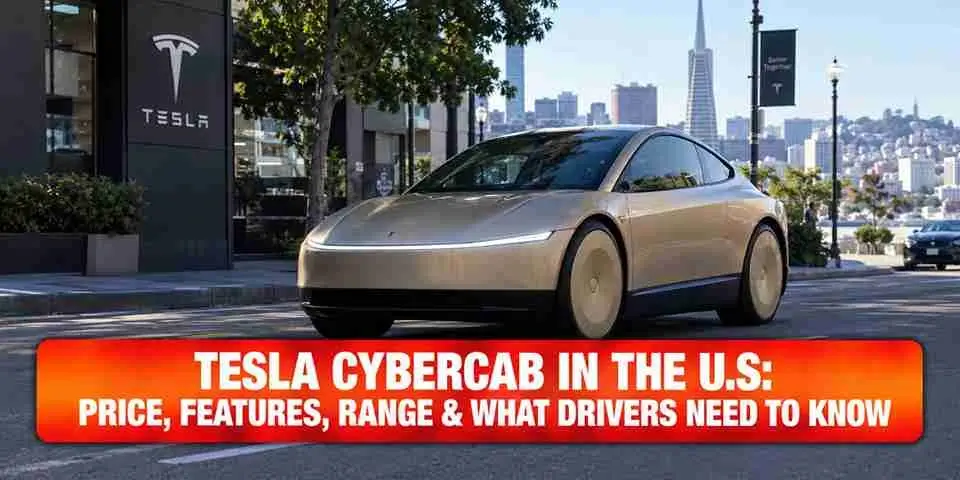
In September 2026, the Tesla Cybercab has moved from a dramatic prototype reveal into limited real-world service in Austin, Texas. Tesla has also started production of the purpose-built autonomous EV at Gigafactory Texas, giving U.S. drivers their first meaningful look at what a production Cybercab could actually become.
The often-quoted $30,000-or-less Tesla Cybercab price remains one of the most attention-grabbing claims surrounding the vehicle. However, there is still an important difference between Tesla’s target and a confirmed retail price. Tesla has not published a conventional consumer MSRP, order configurator, or full retail ownership package for private buyers.
For U.S. consumers, the Cybercab story is therefore less about simply finding the cheapest Tesla and more about understanding a completely different ownership model.
Tesla Cybercab Price USA: Is the $30,000 Target Real?
Tesla CEO Elon Musk originally said the Cybercab would cost less than $30,000 when the vehicle was unveiled in 2024. In February 2026, Musk again indicated that Tesla intended to sell the Cybercab for $30,000 or less by 2027.
That distinction matters because the Cybercab currently being deployed is not being sold like a conventional Model 3 or Model Y. Tesla’s current Cybercab information is centered around its Robotaxi operation, while commercial operators and potential fleet customers can express interest in purchasing vehicles.
There is also a useful affordability comparison for American shoppers. Kelley Blue Book reported that the average new-vehicle transaction price reached $50,089 in August 2026. Even the average compact car transaction price was $27,997, while subcompact SUVs averaged $31,149.
However, buyers should not assume that a $30,000 target automatically means a $30,000 drive-off price. Taxes, registration, insurance, charging infrastructure, financing, maintenance and any future autonomous-service fees would still affect the total cost of ownership.
Tesla Cybercab Specs: What Is Confirmed?
Tesla designed it specifically around autonomous transportation rather than adapting an existing sedan or crossover for driverless operation. The production vehicle has two seats and does not have a steering wheel, accelerator pedal or brake pedal. The Cybercab’s exterior dimensions are relatively compact:
| Specification | Tesla Cybercab |
| Seating | 2 passengers |
| Width | 69 inches |
| Height | 55.4 inches |
| Ground clearance | 5.7 inches |
| Rear cargo volume | 20.2 cu. ft. |
| Steering wheel | None |
| Accelerator pedal | None |
| Brake pedal | None |
Tesla Cybercab Range: What U.S. Drivers Should Know
Range is one of the most searched Tesla Cybercab specifications, but this is an area where consumers should be careful about separating confirmed information from earlier projections. Estimates in the market have circulated around the 200-mile-plus range, but Tesla’s current public Cybercab rider documentation does not establish a final consumer EPA range figure that shoppers can use for comparison with a Model 3, Model Y or another production EV.
A private EV owner in Phoenix, Arizona, may care about highway range, air-conditioning demand and charging availability during a long weekend trip. A Cybercab operating continuously in Austin has a very different use case. It can return to a charging facility between passenger assignments rather than sitting overnight in a residential garage.
For consumers, however, the eventual charging method will be critical. Tesla has demonstrated wireless charging technology for Cybercab, while current vehicles are built around fleet-oriented charging arrangements. Anyone considering personal ownership will need to know whether a retail version supports convenient home charging or requires dedicated infrastructure.
No Steering Wheel or Pedals: Why the Design Matters
Tesla’s current Cybercab documentation confirms that the vehicle does not have a steering wheel, accelerator pedal or brake pedal. That makes the Cybercab fundamentally different from vehicles equipped with Tesla’s FSD Supervised system, where an occupant remains responsible for driving.
The regulatory landscape is already changing. In June 2026, NHTSA began rulemaking to remove the requirement for manual brake pedals from vehicles designed exclusively around automated driving systems. In September, however, NHTSA opened an audit query into Tesla’s certification of Cybercab after its Austin deployment.
For American buyers, the takeaway is simple: autonomous-vehicle regulation is still evolving, and the legal framework surrounding a vehicle without conventional driver controls is not identical to the framework for an ordinary EV.
Tesla Cybercab Release Date: It's Already on U.S. Roads
Tesla reported that Cybercab production began in the first half of 2026, with production taking place at Gigafactory Texas. By July, Tesla said engineering test drives of production Cybercabs had begun on public roads and employee rides were being offered on the Texas factory campus.
As of September 2026, Cybercab rides are available in limited areas of Austin, Texas. Tesla’s current Robotaxi information also lists Austin as the market where Cybercab itself is operating, while Model Y-based Robotaxi services are operating in several other U.S. cities. Austin is therefore an important real-world test case rather than proof that every U.S. city is ready for Cybercab service.
What Cybercab Could Mean for American Drivers
The Cybercab could change transportation in several ways if Tesla successfully scales the concept.
1. A different approach to car ownership
The traditional American vehicle spends most of its life parked. A privately owned car might sit at home overnight, at a workplace during the day and in a parking lot while its owner shops or eats. A robotaxi can potentially spend much more time carrying passengers.
For fleet operators, the key question is no longer simply how much a vehicle costs to purchase. It becomes how many passenger miles that vehicle can generate, how much downtime it requires and how efficiently it can be maintained.
2. A new option for short urban trips
Consider a commuter in Austin traveling several miles between an apartment and an office. With a conventional vehicle, the trip involves ownership, insurance, parking, fuel or charging and maintenance. With a robotaxi, the customer pays for transportation when it is needed.
The same concept could apply to airport transfers, evening trips, restaurant districts and other high-frequency urban routes.
3. Potential changes for fleet businesses
The Cybercab could be particularly relevant to commercial mobility operators. A two-seat autonomous vehicle has a different economics profile from a traditional rideshare vehicle carrying a human driver. There is no driver occupying a seat, and the vehicle is purpose-built around autonomous operation.
But lower operating costs are not guaranteed simply because the vehicle has fewer components. Fleet businesses would still need to account for electricity, tires, insurance, cleaning, repairs, software, downtime, charging infrastructure and vehicle depreciation. The economics will ultimately depend on actual fleet utilization rather than headline estimates.
Final Takeaway
The Cybercab is significant because Tesla is attempting to combine three ideas that have traditionally been separate: an affordable EV, fully autonomous transportation and high vehicle utilization. The $30,000 target is certainly eye-catching in a U.S. market where the average new vehicle now costs more than $50,000. But the final price, range, ownership structure and broader availability remain important pieces of the story.
For now, American drivers should view the Cybercab as a developing transportation platform rather than a conventional Tesla waiting to arrive at every dealership. Its progress in Austin will provide a much clearer picture of how the vehicle performs in everyday traffic, how passengers interact with a car that cannot be manually driven and how regulators respond to a production vehicle built without traditional driver controls.
The next major milestone will not simply be another flashy reveal. It will be whether Tesla can take the Cybercab from a limited Austin deployment to a scalable U.S. transportation network while keeping the vehicle affordable, reliable and compliant with evolving safety requirements.
Frequently Asked Questions
How much will the Tesla Cybercab cost in the USA?
Tesla has targeted a Cybercab price of $30,000 or less, but that is not yet a confirmed consumer MSRP. The final U.S. price, fees and ownership terms have not been fully published.
What is the Tesla Cybercab range?
A final consumer-facing EPA range figure has not been established in Tesla’s current public Cybercab documentation. Earlier estimates have circulated, but buyers should wait for official EPA-rated figures before comparing the Cybercab with other EVs.
When is the Tesla Cybercab release date in the U.S.?
The Cybercab has already entered limited public Robotaxi service in Austin, Texas, in 2026, and Tesla has started production at Gigafactory Texas. Broader U.S. availability and consumer sales remain dependent on Tesla’s rollout and regulatory developments.
For more smart auto hacks, car ownership tips, U.S. car news, trends and vehicle launch updates, just have a look at Mr.Leecar experts.


